
A September 2027 student information system launch may feel a year away, but the decisions that shape a smooth SIS transition begin in autumn 2026. Here's a practical planning calendar to help Canadian independent schools prepare for the change.
Ask a Head of School when they would need to choose a new student information system for September 2027, and most will say spring. Let the year settle, build the case over the winter, take it to the board in April, and sign before summer.
It sounds sensible. It is also about six months late.
When you work backwards from the first day of school, the timeline starts looking very different.
An SIS transition involves more than installing software. There is board approval to secure, existing data to migrate, workflows to configure, reporting requirements to meet, and staff to prepare. All of this needs to fit around the school's calendar, admissions cycle, and daily operations.
If your goal is to start the 2027/28 school year with a new SIS, autumn 2026 is the time to choose your new platform and start planning the transition.
Here's what that timeline looks like, and why getting started earlier can make the entire transition easier.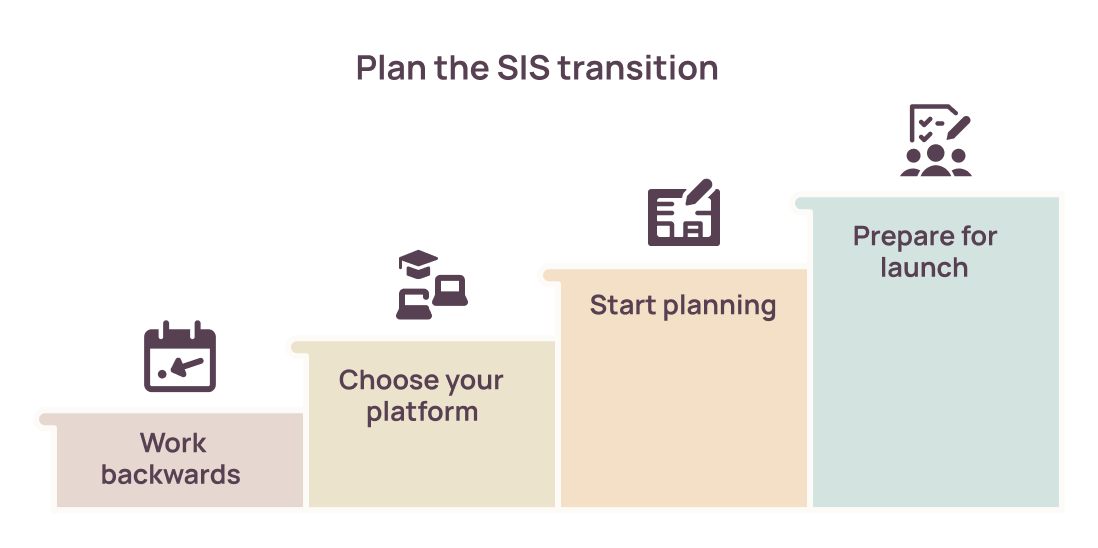
Start with September 2027 and work backwards
The most useful way to plan an SIS transition is to start with the date your school wants to be fully operational and work backwards through the preparation required.
The following timeline provides an illustrative roadmap for an independent K-12 school in Canada planning a September 2027 launch.
The exact schedule will depend on the size of the school, the systems being replaced, and the complexity of the implementation.
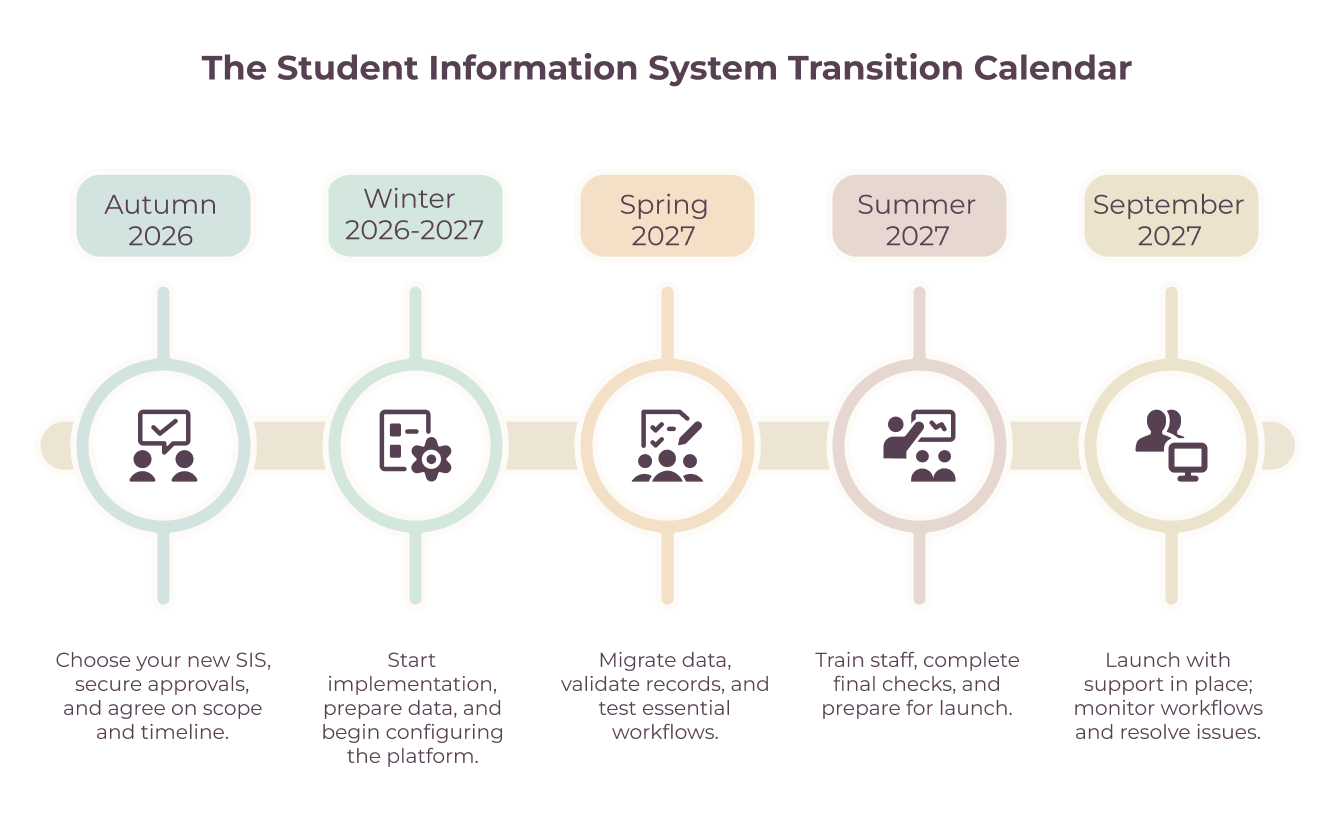
The timeline reveals something important: by the time spring 2027 arrives, a school targeting September implementation should ideally be well into preparation.
If the school is still deciding which system to choose in April, every subsequent stage becomes more compressed.
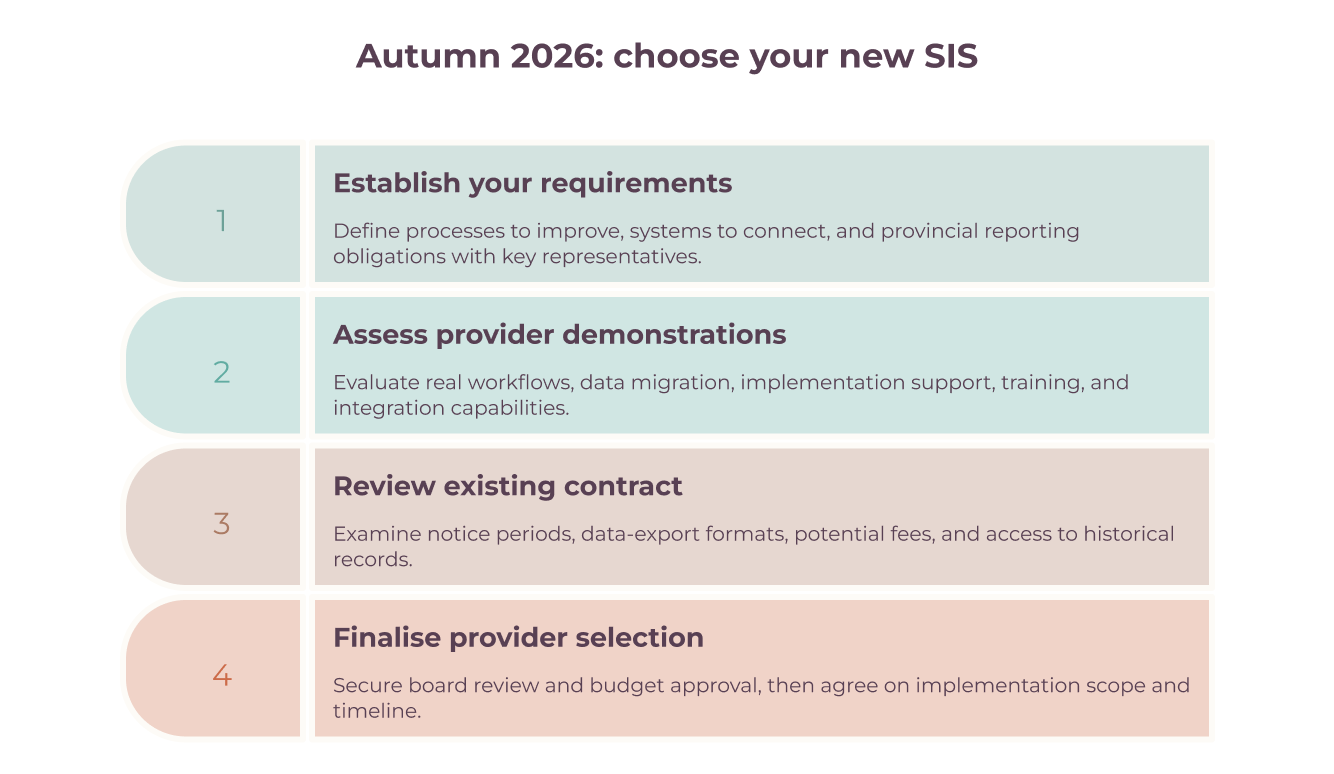
Autumn 2026: choose your new SIS
You know your school needs a new SIS. Now it's time to select the platform and provider.
Establish your requirements, including the processes you want to improve, the systems you need to connect, and any provincial reporting obligations. Involve key representatives from administration, admissions, finance, and IT so that the evaluation reflects how your school actually operates.
Use provider demonstrations to assess real workflows, and ask about data migration, implementation support, training, and integration capabilities.
Review your existing contract, including notice periods, data-export formats, potential fees, and access to historical records. These details can affect your transition schedule.
Allow time for board review and budget approval, taking scheduled meetings and any supporting documentation into account. Finalise your provider selection, secure the necessary approvals, and agree on the implementation scope and timeline before the year ends.
Your goal: enter 2027 knowing which system you're moving to, who will support the transition, and what the implementation will involve.
Winter 2026–27: start implementation and prepare your data
With your provider selected, it's time to move from planning to implementation.
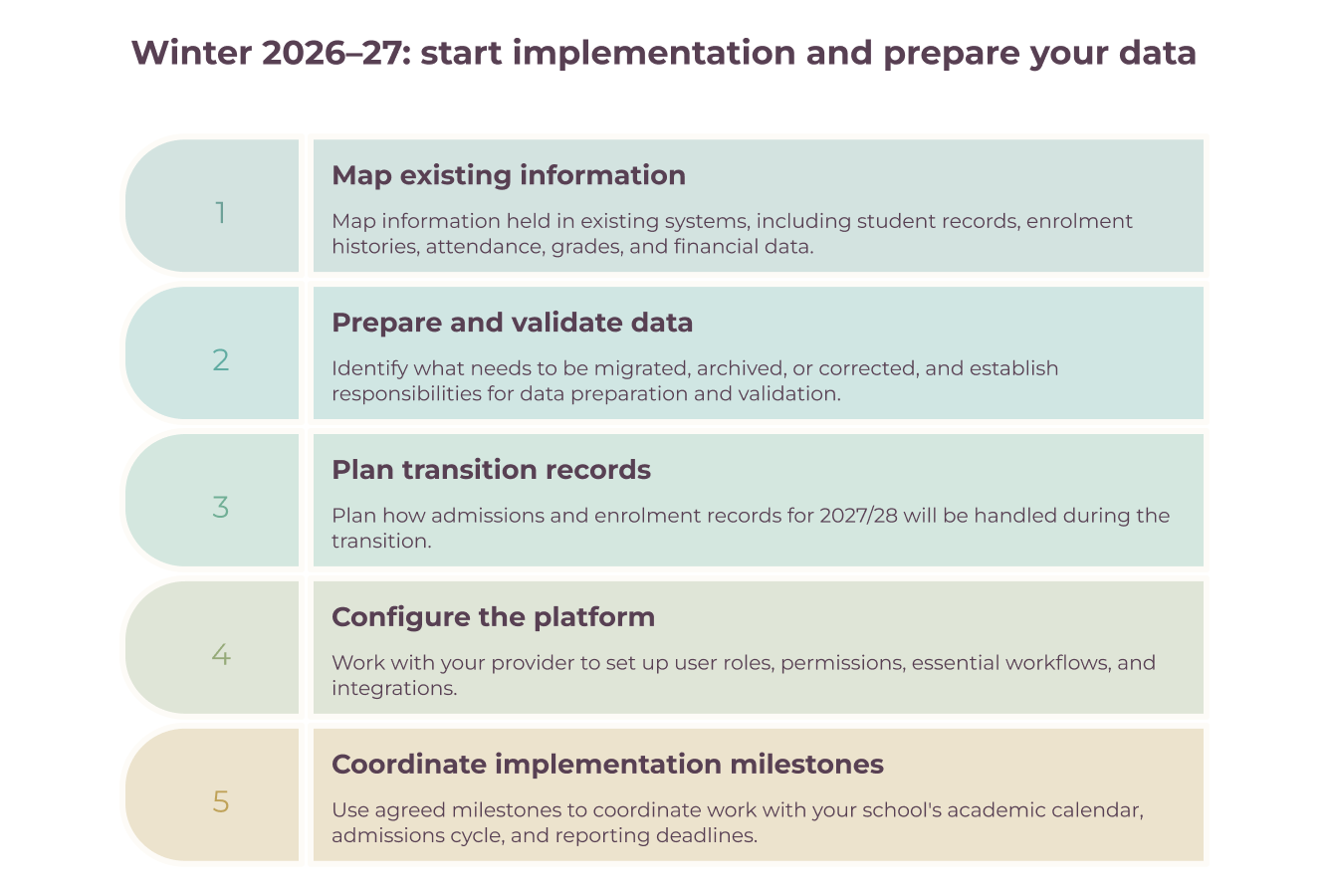
Begin by mapping the information held in your existing systems, including student records, enrolment histories, attendance, grades, and financial data. Identify what needs to be migrated, archived, or corrected, and establish responsibilities for data preparation and validation.
Plan how admissions and enrolment records for 2027/28 will be handled during the transition, particularly if applications are already being processed in the existing system.
Work with your provider to begin configuring the platform around your school's requirements. This includes setting up user roles, permissions, essential workflows, and integrations with systems that will remain in place.
Use the agreed implementation milestones to coordinate the work with your school's academic calendar, admissions cycle, and reporting deadlines.
Your goal: have the foundations of your new system in place, with data preparation and configuration underway before spring.
Spring 2027: migrate data and test your new system
With the foundations in place, the focus shifts to transferring information and making sure the new system works as expected.
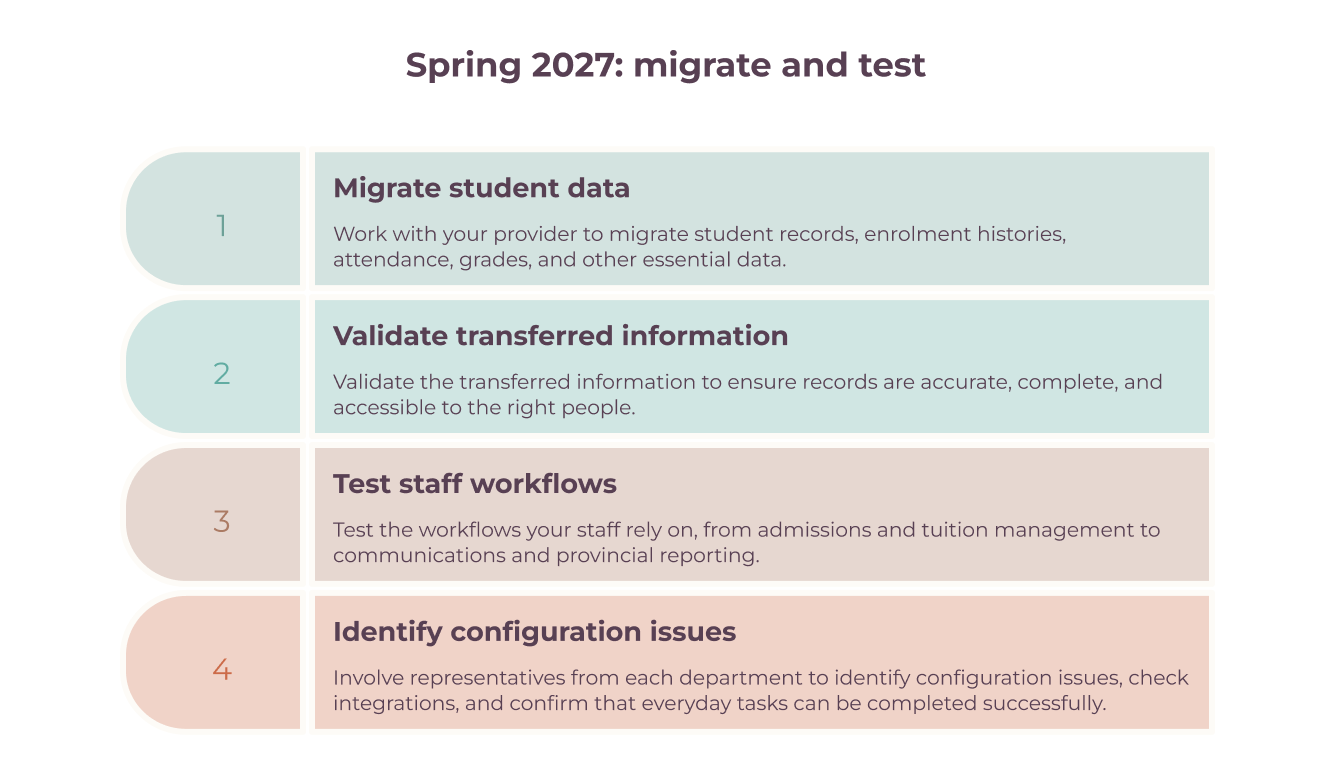
Work with your provider to migrate student records, enrolment histories, attendance, grades, and other essential data. Validate the transferred information to ensure records are accurate, complete, and accessible to the right people.
Test the workflows your staff rely on, from admissions and tuition management to communications and provincial reporting. Involve representatives from each department to identify configuration issues, check integrations, and confirm that everyday tasks can be completed successfully.
Your goal: complete initial data migration, validate essential workflows, and identify any issues with enough time to resolve them before summer.
Summer 2027: train your staff and prepare for launch
By summer, the main implementation work should be complete. The remaining weeks are for final adjustments, staff preparation, and making sure everything is ready for the new academic year.
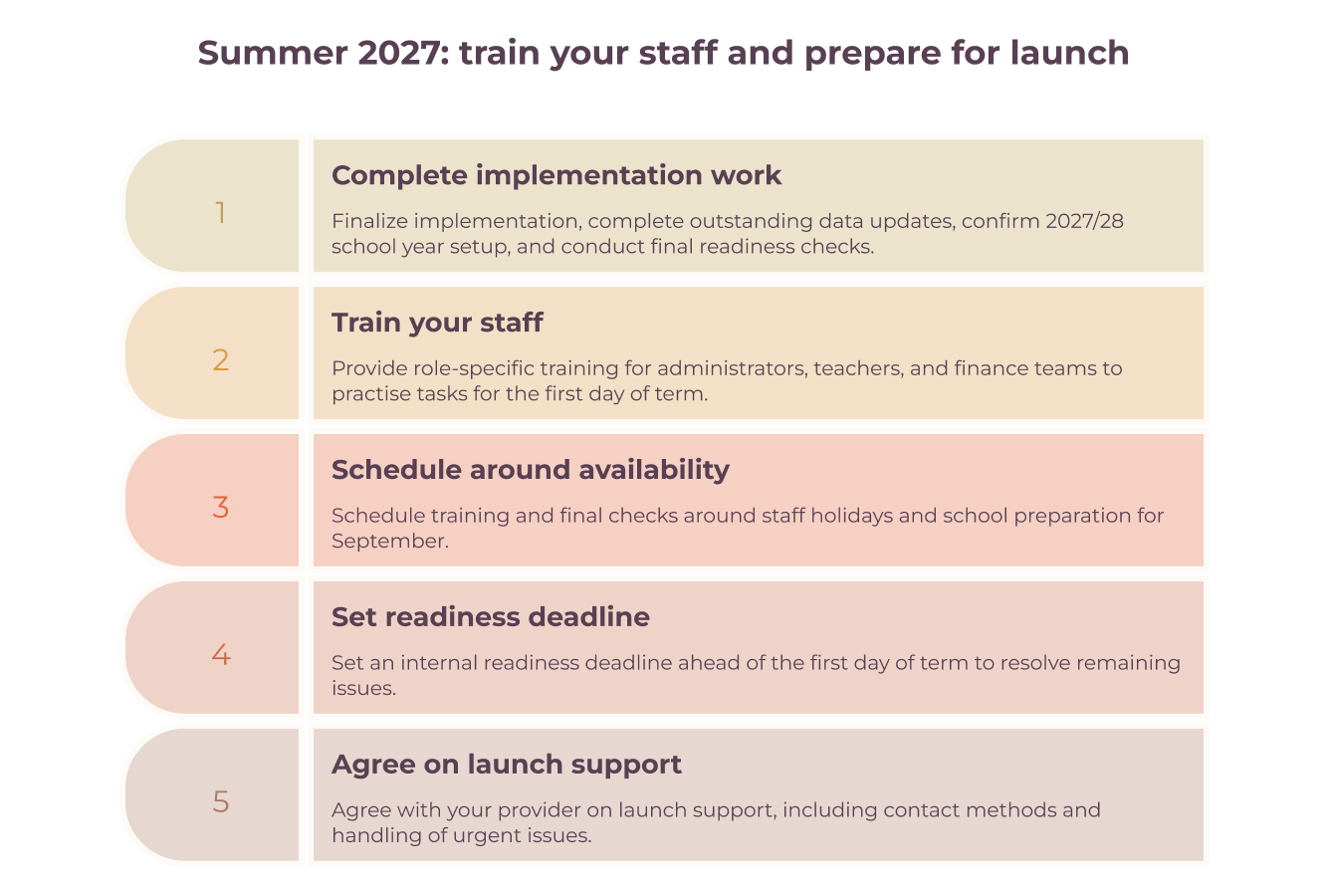
Complete any outstanding data updates, confirm the 2027/28 school year setup, and conduct final readiness checks. Provide role-specific training so administrators, teachers, finance teams, and other staff can practise the tasks they'll perform from the first day of term.
Remember that summer is also when staff take holidays and schools prepare for September. Schedule training and final checks around staff availability.
Set an internal readiness deadline ahead of the first day of term, leaving time to resolve any remaining issues before the school relies on the new system.
Agree with your provider on launch support, including whom to contact, how questions will be handled, and what happens if an urgent issue arises.
Your goal: enter September with your new SIS ready, your staff trained, and a clear support plan in place.
September 2027: launch with support in place
Going live is a milestone, but the transition doesn't end there. During the opening weeks, monitor essential workflows, collect feedback from staff and families, and work with your provider to resolve any outstanding issues.
Once daily operations are stable, review whether the new system is delivering the improvements your school set out to achieve.
For an example of how schools can continue improving their processes after implementation, see how St. Margaret's School has developed its use of MySchool over time.
What happens if you wait until spring 2027?
A spring decision does not automatically rule out a September launch. Smaller transitions, limited implementations, and schools with straightforward data requirements may be able to move considerably faster.
By April 2027, a school following this timeline should already be migrating data and testing its new system. A school only beginning to evaluate providers at that point still has to arrange demonstrations, secure approval, agree on a scope, and plan implementation before any of that work can begin.
Meanwhile, staff is approaching one of the busiest periods of the academic year.
The school may then have to make compromises: introduce fewer modules, postpone improvements to existing processes, reduce the time available for testing, or plan a phased transition extending beyond September.
Some of these may be sensible decisions. A phased implementation can be the right approach for a school's needs.
The important distinction is whether the school chooses that approach deliberately or adopts it because there is no longer enough time to prepare for the original plan.
Starting earlier gives school leaders greater control over the scope, timing, and pace of the transition.
A successful SIS transition starts long before go-live
Replacing a student information system is an opportunity to reduce manual administration, connect information across departments, and improve how your school operates. Getting there requires the right platform, a realistic timeline, and preparation.
At MySchool, we help K–12 independent schools work through that preparation with guidance from a dedicated Customer Success Manager and an experienced support team. From data migration and configuration to staff training, our onboarding process helps your team prepare for the everyday work it will carry out in the new system.
Your Customer Success Manager gets to know your school's priorities and processes, helps coordinate the next steps, and works with your team as questions arise. Role-based training gives staff guidance relevant to their responsibilities, so they can build confidence in the tasks they will handle each day.
That relationship continues after launch, giving your school an ongoing point of contact as staff settle in, processes evolve, and new needs emerge.
If September 2027 is your target, the time to start planning is now.
Talk to the MySchool team about what a realistic SIS transition could look like for your school.
Related Posts
The Student Information System Transition Calendar Most Schools Discover Too Late
A September 2027 student information system launch may feel a year away, but the decisions that shape a smooth SIS transition begin in autumn 2026. Here's a practical planning calendar to help Canadian independent schools prepare for the change.
2026/2027 School Year Calendar for Independent Schools in Canada
Bring key dates into your school’s planning with our 2026/2027 school year calendar for independent schools in Canada, covering holidays, community observances, and provincial reporting deadlines.

Product Update: Introducing the MySchool Diploma Module
Set your school’s graduation requirements in MySchool and track each student’s progress against them.