.png)
Licence fees and overtime are the costs you can see. The bigger half never reaches a budget line at all. This post walks through where the hidden costs of fragmented systems sit, and how to put a rough figure on them before September starts.
Earlier this summer we suggested a small exercise. Sit down with the people who run admissions, enrolment, billing and reporting, and ask each of them what took far more effort this year than it had any right to, and who ended up holding it together.
Some schools did that on paper, most carry the answers around in their heads. Either way, you have a list.
This list is your effort documented.
Schools are very good at praising effort but much less practised at pricing it. Nobody approved this spending in a meeting, and most of it never reached a budget line. It builds up quietly and accumulates at schools that are otherwise run beautifully.
This article gives you a way to put a figure on the cost your team already absorbed this year, before another one starts adding to it.
Here are the costs that show up again and again in schools running on fragmented systems. A few of them you can already see. The rest are hidden, which makes them even worse.
The Costs You Can See
Some of this is already in your budget, and you could point to it today. Subscription fees for two tools that overlap. The support contract for the system nobody likes using. Overtime in the last week of June. The temporary help you brought in to survive report card season. Add those lines up, and you get a real figure.
It will look manageable. Which is exactly the problem, because this is the smaller half of what you are paying.
The Costs You Cannot See
The rest never reaches a budget line at all. It gets absorbed by staff, by families, and by the calendar. Most schools make the decision to keep their current setup based only on the visible half, which is why the decision so often comes out wrong.
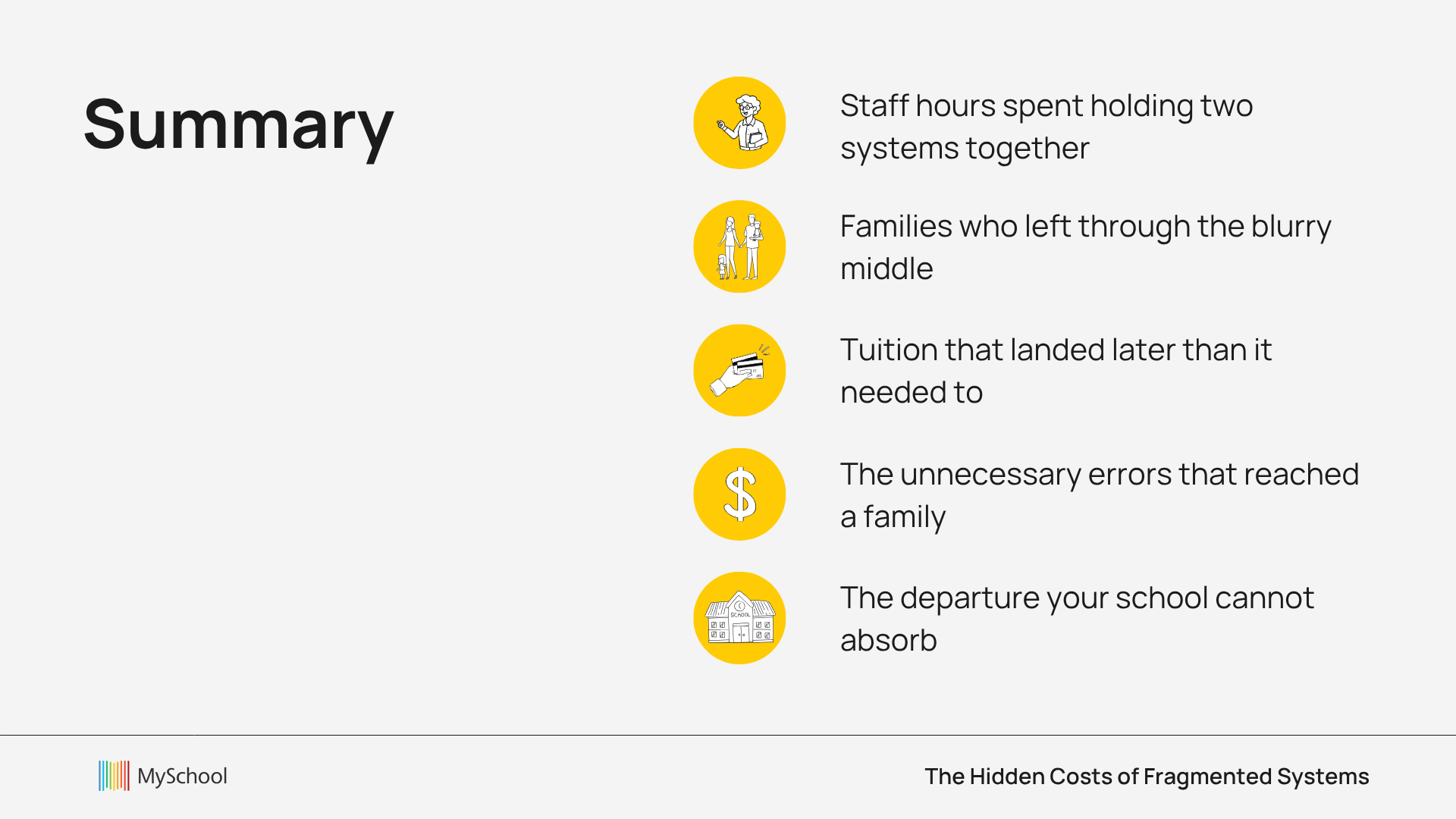
Hidden Cost #1: The Hours Nobody Counts
Start with the obvious one. Someone at your school spends part of every week doing work that exists only because two systems will not talk to each other. Re-keying a student's details into a second database, or chasing a figure through email because no report will produce it.
Each task is small enough to feel unremarkable. Put a rate against it, and it stops being small. Say two people lose five hours each to that work in a normal week. Across a forty-week school year, that is four hundred hours. A school administrative salary of around $50,000 works out to roughly $30 an hour once benefits and payroll costs are counted, so those hours cost you in the region of $12,000 a year.
That is ten weeks of full-time work, and none of it produced anything new.
Hidden Cost #2: The Families Who Left Through the Blurry Middle
Scattered admissions data hides the middle of your funnel. You know how many families enquired and how many eventually enrolled. What happened in between stays vague.
So a family that went quiet after a tour looks exactly like a family that was never serious, and nobody follows up because nobody can see the difference.
One family lost that way costs far more than a single year of tuition. Count every year they would have stayed, and the siblings who would have followed them in.
Hidden Cost #3: Tuition That Lands Later Than It Should
When payment reminders depend on someone remembering to send them, they go out late during the weeks the office is busiest. Those are the same weeks the school needs the money to arrive.
Late tuition puts pressure on cash flow, and it comes with a second charge attached. The uncomfortable follow-up conversations land on staff who did nothing to cause the delay.
Hidden Cost #4: The Errors That Reached a Family
Every school has a version of this story. An invoice with the wrong amount on it, a message about a child sent to a parent who should not have received it, because the family update went into one system and never reached the other.
Your team catches most of these. Your team catches most of these. One that gets through is forgivable, and families are generous about the occasional slip. What they respond to is the pattern, because the third time in a year stops looking like bad luck and starts looking like how the school is run.
That costs you something harder to price, which is a family's confidence that the school has its house in order. Re-enrolment runs on that confidence, and families who lose it rarely announce it. They simply do not come back.
Put a figure on one of those departures. A student who leaves after Grade 6 instead of staying through Grade 12 takes six years of tuition with them. At $10,000, which sits near the bottom of the range for Canadian independent day schools, that single family is $60,000.
Hidden Cost #5: The Departure Your School Cannot Absorb
Ask what happens if your registrar or business officer resigns in March. Fragmented systems concentrate knowledge in people, because someone has to hold the map of where everything actually lives.
Losing that person means recruitment costs and months of reduced capacity, with a handover that cannot be complete because most of what they knew was never written down anywhere.
The same arrangement wears people down long before they hand in a letter. Staff who spend their year fighting the tools rarely say that on the way out, and they still go.
Doing the Math Yourself
You do not need a consultant for this. Take three items from your July list, estimate the hours each one swallows in a normal week, multiply by forty, and apply an hourly rate for the people doing the work.
Then add one family. Not a hypothetical family. The one you can already name, who left for reasons your team half suspects but nobody recorded.
The total will be conservative, because it leaves out everything you have no way to measure yet. It will still be larger than anyone at the table expects, and it will be something your board can respond to. A feeling about workload is easy to defer. A number is much harder to put off.
What To Do Next
Whatever total you land on, notice one thing about it. That amount is annual. Your school paid it last year, and it is already booked in for years to come unless something changes.
Which brings you to the question the rest of the summer is for. Some of what you are paying for is process, and better habits will clear it without spending a dollar. Some of it is structural, and no amount of discipline gets around it.
Telling those two apart is the next piece of work, and it is a great deal easier in August than it will be in October.
Related Posts
Fix the Process or Replace the School Management System? How to Tell Which Problem You Have
Before you retrain the team or start shopping for new software, find out where the extra work actually begins. Learn how to test whether better ownership, training, and process design will solve the issue — or whether the limitation sits in the system itself.
11 Essential Tools for Canadian Independent School Administrators
Canadian independent school administrators juggle dozens of tasks every day. This guide highlights 11 tools that can make that work simpler, faster, and easier to manage.

The First 30 Days Back: Where School Operations Start to Crack
The first 30 days back show you how your school’s operations really hold up under pressure. This post helps you separate normal start-of-year friction from operational issues that followed you from last year.