.png)
Before you retrain the team or start shopping for new software, find out where the extra work actually begins. Learn how to test whether better ownership, training, and process design will solve the issue — or whether the limitation sits in the system itself.
When something keeps going wrong in school operations, there are two easy explanations.
The process is broken. Or the system is broken.
Both can be true. But they require very different fixes.
If the real problem is unclear ownership, inconsistent training, or a process nobody follows, replacing the software will simply move the same problem somewhere new. On the other hand, if the platform itself forces staff into duplicate entry, disconnected workflows, or manual workarounds, another procedure document will not solve much either.
Before changing either one, you need to know where the constraint actually sits.
Could this process work well in the system you already have?
Pick one recurring piece of work that causes frustration. It could be updating student information, preparing reports, processing enrolment changes, or communicating with families.
Then strip away the history around it and ask:
If everybody followed the agreed process perfectly, could the work be completed efficiently using the tools you already have?
That question separates a surprising number of process problems from system problems.
If the answer is yes, the issue may be training, ownership or process design.
If the answer is no — because somebody would still need to re-enter information, move data manually, maintain a separate spreadsheet or jump between systems — then the constraint is probably deeper.
Good process can make difficult work easier. What it cannot do is remove a limitation built into the technology.
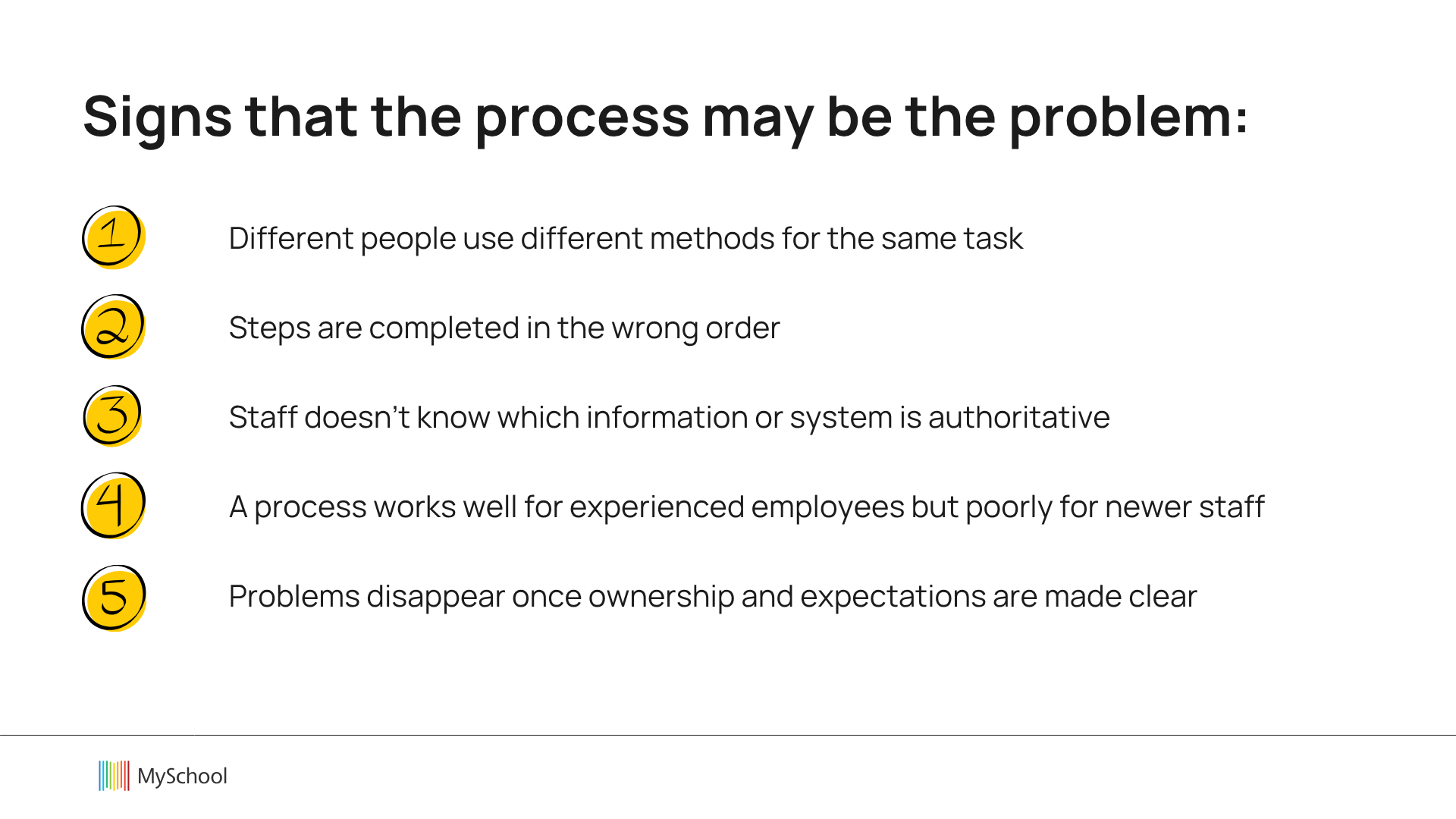
Signs that the process may be the problem
Sometimes the software is capable of supporting the work, but the way it is being used has drifted over time.
One person does the task one way. Someone else has their own shortcut. Nobody is quite sure who owns a particular step. A new employee learns by watching whoever happens to be available. Features that would simplify the work exist but are not being used. Before long, the process exists mostly in people’s heads.
In those situations, replacing the platform can be nothing more than an expensive distraction.
Look for patterns such as:
- Different people using different methods for the same task
- Steps being completed in the wrong order
- Staff not knowing which information or system is authoritative
- A process working well for experienced employees but poorly for newer staff
- Problems disappearing once ownership and expectations are made clear
Those are clues that the process deserves attention first.
Documenting the workflow, clarifying responsibility, and providing focused training may solve considerably more than a new platform would.
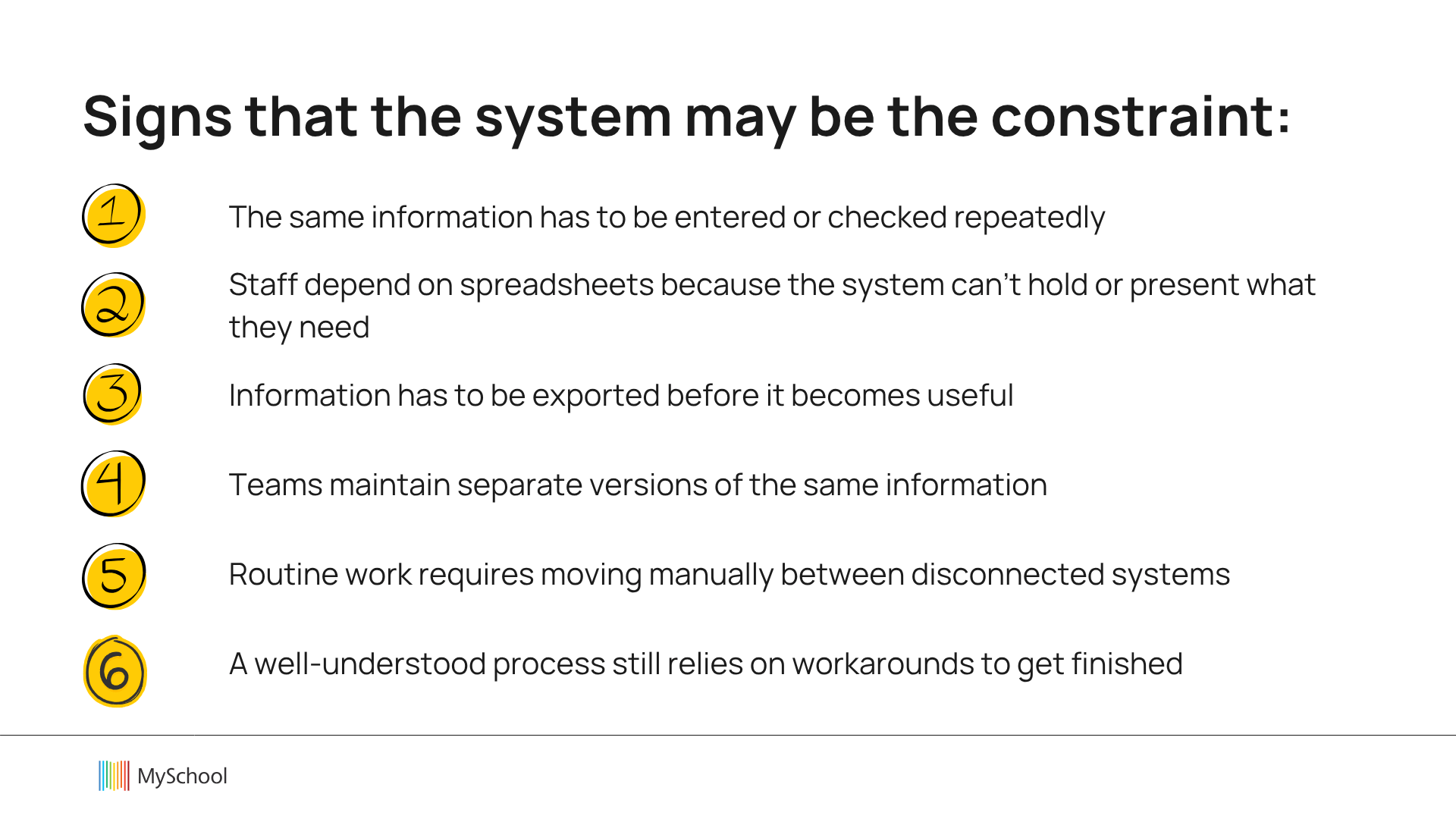
Signs that the system may be the constraint
But what if the process is already clear?
What if everyone knows what to do, follows the same steps, and still ends up doing extra work simply to get the job finished?
That is a different problem.
Perhaps information has to be entered in more than one place. A report can only be produced after somebody exports and reorganises the data. Two departments need the same information but cannot work from the same record. A workflow stops at a certain point because the system simply does not support the next step.
These are not necessarily failures of discipline.
They are signs worth investigating when:
- The same information has to be entered or checked repeatedly
- Staff depend on spreadsheets because the system cannot hold or present what they need
- Information has to be exported before it becomes useful
- Teams maintain separate versions of the same information
- Routine work requires moving manually between disconnected systems
- A well-understood process still relies on workarounds to get finished
The important distinction is that these problems remain even when people follow the process correctly.
You can document the workaround. You can train people to perform it consistently. You can even make it relatively efficient.
But it is still a workaround.
Does the problem follow the person or the workflow?
There is another useful way to diagnose the issue: look at where the problem appears.
Suppose one staff member consistently struggles with a task while everybody else completes it without much difficulty. That points towards training, role clarity or an individual process issue.
Now suppose every person who takes responsibility for that workflow eventually creates the same spreadsheet, manual check or extra step.
That tells you something different.
The workaround is not following the person. It is following the work.
This is especially useful in schools where experienced staff have spent years making imperfect systems function remarkably well. Their knowledge can make structural limitations difficult to see.
When someone leaves, changes role or takes time away, what looked like a functioning process can suddenly become much more fragile.
What would happen if you fixed the process perfectly?
Before considering a system change, imagine that you solved every process problem you could.
Everyone receives proper training.
Every step has an owner.
The workflow is documented.
Everyone follows it consistently.
Now ask: what work would still remain?
If the recurring problem disappears, you probably had a process problem.
If staff would still be copying information, reconciling records, exporting data or maintaining parallel tools, you have identified something process improvement cannot remove.
That does not automatically mean replacing the entire system. The answer could be a configuration change, an integration, a different module or a smaller change to the technology you already use.
Do not confuse a better workaround with a solved problem
Schools are very good at making imperfect processes function.
Often, almost too good.
A spreadsheet becomes neatly organised. A manual check gets added to the monthly routine. Someone documents the export-and-import process carefully enough that another employee can follow it.
Those improvements matter. They reduce risk and make the day-to-day work easier.
But they can also make a structural problem easier to live with without actually removing it.
The question is not simply, “Can we make this process work?”
Most capable teams can.
The better question is: “Should this work require these extra steps in the first place?”
That is where the difference between process improvement and system change becomes much clearer.
Fix the constraint, not the symptom
Replacing technology every time a workflow becomes frustrating would be expensive, disruptive, and unnecessary.
But so is asking staff to keep refining a process that is fundamentally constrained by the tools underneath it.
The goal is not to prove that the process is broken. Nor is it to prove that the system is broken.
It is to identify the point where the unnecessary work begins.
If clearer ownership, better training, and a consistent workflow remove the problem, fix the process.
If the unnecessary work remains even after those things are in place, look at the system.
Sometimes the answer really is a better process.
And sometimes the process has already been doing everything it can. If the same limitations are still there, it may be time to look at the system underneath it.
MySchool is a unified school management system built for independent schools in Canada that want to bring student information, admissions, tuition, communications, reporting, donations, and day-to-day administration into one connected platform.
If your current school management system is creating more work than it removes, see how MySchool could work as an alternative.

Related Posts

Fix the Process or Replace the School Management System? How to Tell Which Problem You Have
Before you retrain the team or start shopping for new software, find out where the extra work actually begins. Learn how to test whether better ownership, training, and process design will solve the issue — or whether the limitation sits in the system itself.
11 Essential Tools for Canadian Independent School Administrators
Canadian independent school administrators juggle dozens of tasks every day. This guide highlights 11 tools that can make that work simpler, faster, and easier to manage.

The First 30 Days Back: Where School Operations Start to Crack
The first 30 days back show you how your school’s operations really hold up under pressure. This post helps you separate normal start-of-year friction from operational issues that followed you from last year.