Soul of a school. Strength of a business.
Every school exists to educate. Its purpose is to shape how young people think, grow, and find their place in the world.
But behind that purpose is a real organization. One that has to collect tuition, manage payroll, support teachers, protect student data, and make financial decisions that shape what the school can do next.
The mission is clear. The system supporting it often is not.
That is where many school leaders feel the tension.
They know what their school stands for. They also see how much time disappears into admin, how often decisions are made without solid information, and how much avoidable pressure lands on people who should be focused on students, staff, and strategy.
Running a school with more operational discipline does not pull it away from its mission. It helps protect the mission from avoidable pressure.
Because the stronger the system behind the school, the more space leaders, teachers, and staff have for the work only they can do: education.

A Quick Diagnostic: Is your school running as a system or a patchwork?
The signs are usually quieter than that.
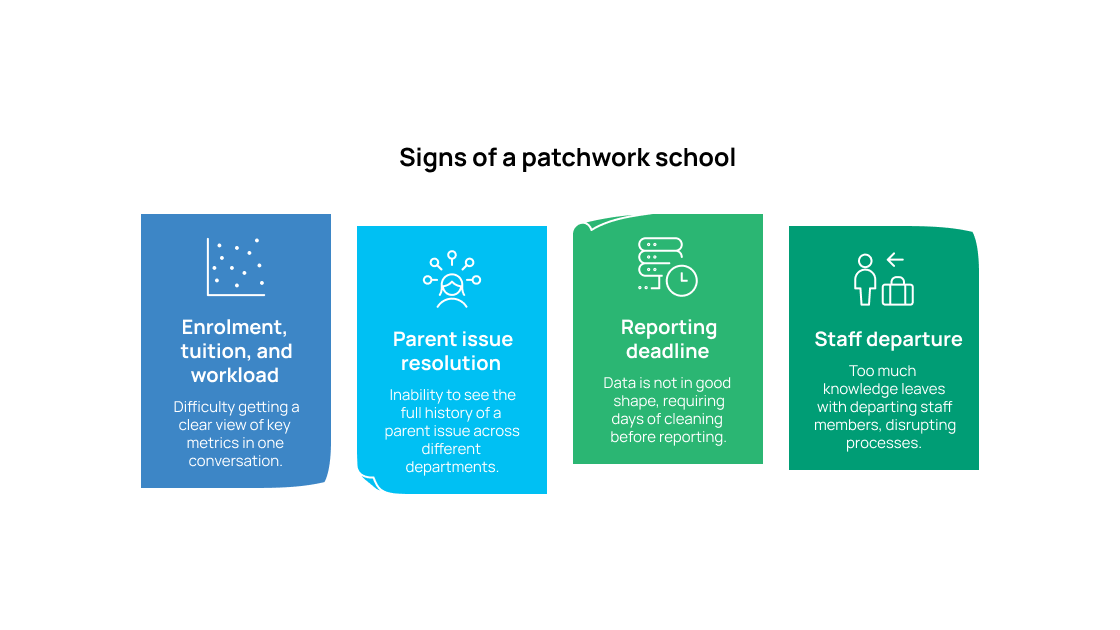
Think about the last time you needed a clear view of enrollment, outstanding tuition, and staff workload in the same conversation. Could your team answer quickly, or did someone need to pull numbers from several places first?
Or think about a parent issue that touched admissions, billing, and communication. Could one person see the full history, or did the family have to repeat the story while staff checked email threads, spreadsheets, and separate tools?
When a reporting deadline arrives, is the data already in good shape, or does the school spend days cleaning it up?
When a staff member leaves, does the process stay intact, or does too much knowledge leave with them?
These are not unusual situations. They are how many schools manage daily work.
The problem is rarely one bad system or one careless process. More often, tools were added over time to solve separate problems. Admissions here. Finance there. Communication somewhere else. Each tool may work on its own. Together, they create gaps.
The school still runs, but only because people are filling those gaps manually.
They re-enter data. They double-check records. They chase updates. They carry the parts of the system that the system itself should carry.
That model can survive for a while. It does not scale well, and it does not give school leaders the clarity they need to lead with confidence.
The Proof: What this looks like in practice
Stronger operations are not abstract.
They show up in the ordinary work of the school.
A report takes minutes instead of hours because the data is already connected. A parent question is answered with context because communication, billing, and student records are not scattered across separate places. A tuition issue is spotted earlier because receivables are visible before the pressure builds. An admissions follow-up happens on time because the next step is owned, visible, and part of the workflow.
These changes may sound small on their own.
Together, they change how the school feels to run.
Staff spend less time checking, chasing, and rebuilding information. Leaders have more confidence in the numbers they bring to the board. Families experience a school that feels organized and responsive. Teachers have easier access to the student context they need.
The goal is not operational perfection.
The goal is a school that runs well enough for people to focus on the work that drew them to education in the first place.
And once you look at the daily work this way, it becomes easier to see why school leadership often feels harder than it should.

When teachers do admin work, students feel it
The drag does not stop with leadership.
Teachers often lose time to systems that make simple work harder than it needs to be. They move between platforms, search for missing context, repeat updates, or wait for information that should already be available.
That time has a cost.
Every hour spent navigating disconnected systems is an hour not spent preparing a better lesson, supporting a student, speaking with a family, or noticing something early enough to help.
Operational weakness does not always appear in a report. But it still reaches the classroom.

Operational strength protects educational quality
Better systems create more room for better school work.
Leaders spend less time chasing clarity and more time setting direction. Teachers can act from a fuller view of each student. Families experience the school as more consistent, responsive, and trustworthy. Boards can govern from current information instead of reconstructed updates.
These improvements are not the final goal.
They are the conditions that make the real work easier to protect.

1. Operations: Replace workarounds with one operating model
What good looks like
A well-run school is not one where staff work harder to keep everything moving.
It is one where the work itself is easier to carry.
Admissions, finance, student records, communication, and reporting sit inside a connected operating environment. When information changes in one place, the people who need that information can see it. Workflows are clear enough for new staff to follow and stable enough to survive a busy term.
That does not make the school rigid. It makes the school less dependent on hidden effort.
Where schools usually break down
Most school workarounds start as reasonable fixes.
A spreadsheet tracks something the main system cannot handle. An admissions process grows around one experienced staff member. A finance report is built manually because that is the only way to get the numbers right. A communication step lives in someone’s inbox because no better place exists.
Over time, those fixes become the operating model.
Institutional knowledge lives in people more than systems. Onboarding takes longer than it should. A simple question about enrollment, tuition, or workload needs three people before the answer feels safe to use.
That is the moment the workaround has stopped being helpful and started becoming the system.
What leading businesses get right
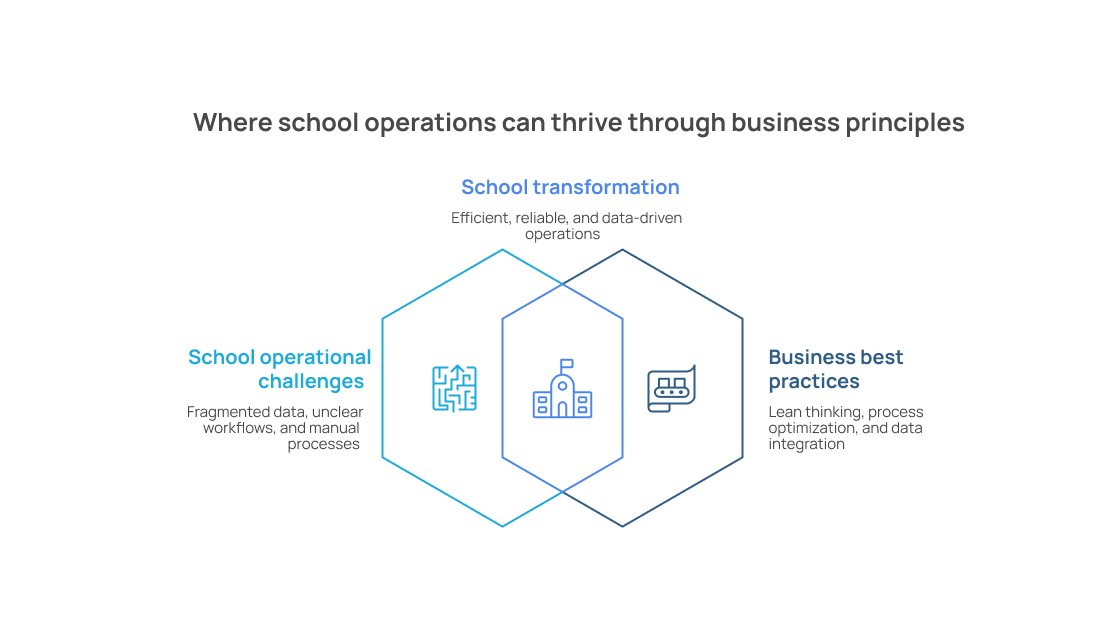
Toyota’s production approach is useful here because it focuses on wasted effort and unclear handoffs.
The core idea is simple: each step should add value, problems should be visible, and people closest to the work should have enough clarity to improve it.
That principle translates well to school operations.
A school should be able to see where information slows down, where work is repeated, where staff are compensating for system gaps, and where a process depends too much on one person.
What that looks like in a school
A school does not need enterprise software built for a global manufacturer.
It needs one clear operational base.
When a family updates contact details, the right records update with it. When a student moves from applicant to enrolled, admissions, tuition, communication, and student records do not have to rebuild the same context. When leaders ask for enrollment or receivables, the answer comes from a trusted system rather than a manual assembly process.
Lean thinking in a school context means asking practical questions.
-
How many times is the same data entered?
-
How many people touch one routine report?
-
How many steps exist only because two systems do not speak to each other?
-
How much of this process would break if one experienced staff member left?
Those questions usually reveal the first place to improve.
A 30-day starting plan
Choose one core workflow and map it from start to finish. Admissions and tuition billing are usually good starting points because they touch families, finance, staff time, and leadership visibility.
Count the systems involved. Count the handoffs. Count the manual checks. Then identify the points where staff already know the process slows down.
After that, choose one routine leadership question and time how long it takes to answer accurately. If a basic operational question takes more than 30 minutes to answer with confidence, the operating model is carrying too much friction.
One KPI worth watching
Track the time it takes to produce a standard operational report, such as enrollment numbers, outstanding tuition, or staff workload.
The goal is not a prettier report. The goal is an answer the school can trust quickly.
Go deeper
2. Parents: Design a parent experience that builds trust
What good looks like
A strong parent experience does not make families work to understand the school.
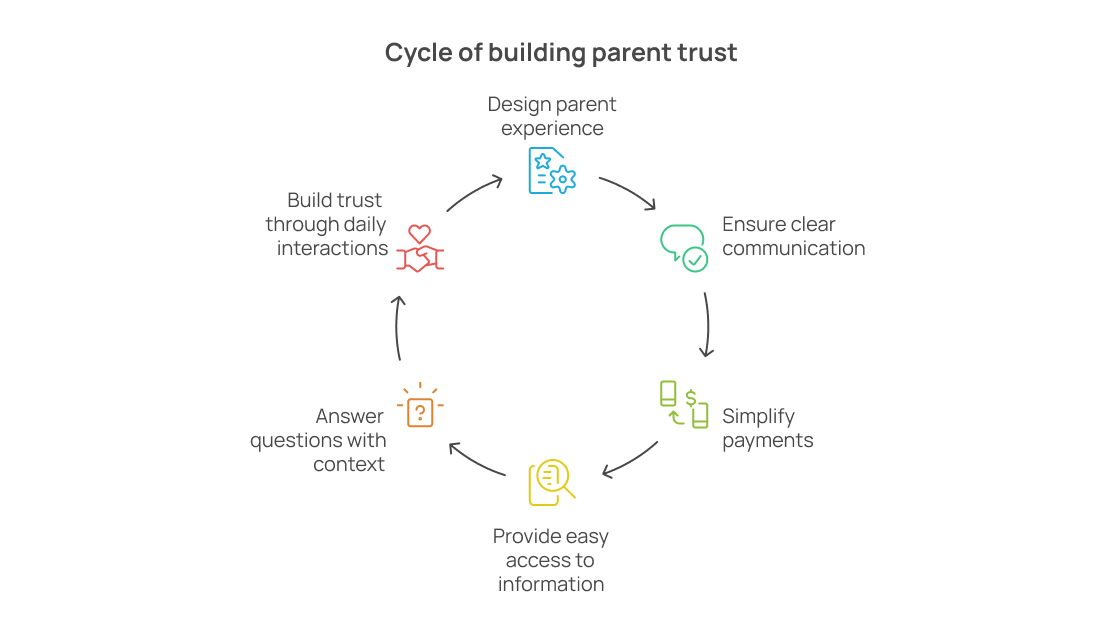
Communication is clear. Payments are straightforward. Important information is easy to find. Questions are answered with context. Parents do not have to check three platforms, repeat themselves, or guess who owns the next step.
Trust is built in those ordinary moments.
Not only through exam results, open days, or annual surveys, but through the daily experience of dealing with a school that feels organized and responsive.
Where schools usually break down
Parent trust usually erodes in small ways.
A billing message arrives without enough context. A school-wide update is missed because it was sent through the wrong channel. One department says something that another department cannot see. A parent explains the same issue twice because the person responding does not have the full history.
None of this means the school does not care.
It means the parent experience has not been designed as one experience.
Communication, payments, attendance, student information, and support sit in different places, owned by different people. The school sees internal systems. The parent feels one relationship.
When that relationship feels fragmented, trust becomes harder to maintain.
What leading businesses get right
Apple and Amazon are useful examples because they show how much trust comes from coherence and low effort.
Apple’s experience feels consistent across products, stores, service, and support. Amazon reduces uncertainty by making status, next steps, and issue resolution easy to understand.
Schools do not need to copy consumer brands.
But the principle transfers clearly: experience quality is shaped by systems.
When people know where to go, what happens next, and who has the context, confidence grows.
What that looks like in a school
In a school, the parent experience should be designed rather than improvised.
Families should know where to find reports, how to pay fees, whether an absence was recorded, where updates are posted, and how to ask for help. These pathways should not depend on a parent already understanding the school’s internal structure.
A connected platform helps because staff can respond from shared context.
If a parent asks about a charge, a missed message, attendance, or a student concern, the person helping them should not have to start from zero. They should be able to see the relevant record and answer in a way that feels informed.
That changes the tone of the interaction.
The parent feels known. The school feels composed.
A 30-day starting plan
Review the parent journey across a typical month. Include billing, attendance, report access, forms, event updates, school-wide communication, and routine questions.
Look for the points where parents are most likely to get delayed, confused, redirected, or asked to repeat information.
Then choose one high-friction area and simplify it. Fee payments, absence reporting, and school-wide communication often produce quick gains because they affect many families.
Finally, review how parent questions are handled. If routine issues pass through several inboxes or require staff to rebuild context manually, define clearer ownership and bring the relevant information into one place.
One KPI worth watching
Track the time it takes to resolve routine parent questions.
If common questions about billing, attendance, communication, or access require several handoffs, the parent experience is absorbing internal fragmentation.
Go deeper
3. Students: Build a complete, live view of every student
What good looks like
A school that supports students well gives teachers, advisors, and leaders one usable view of the student.
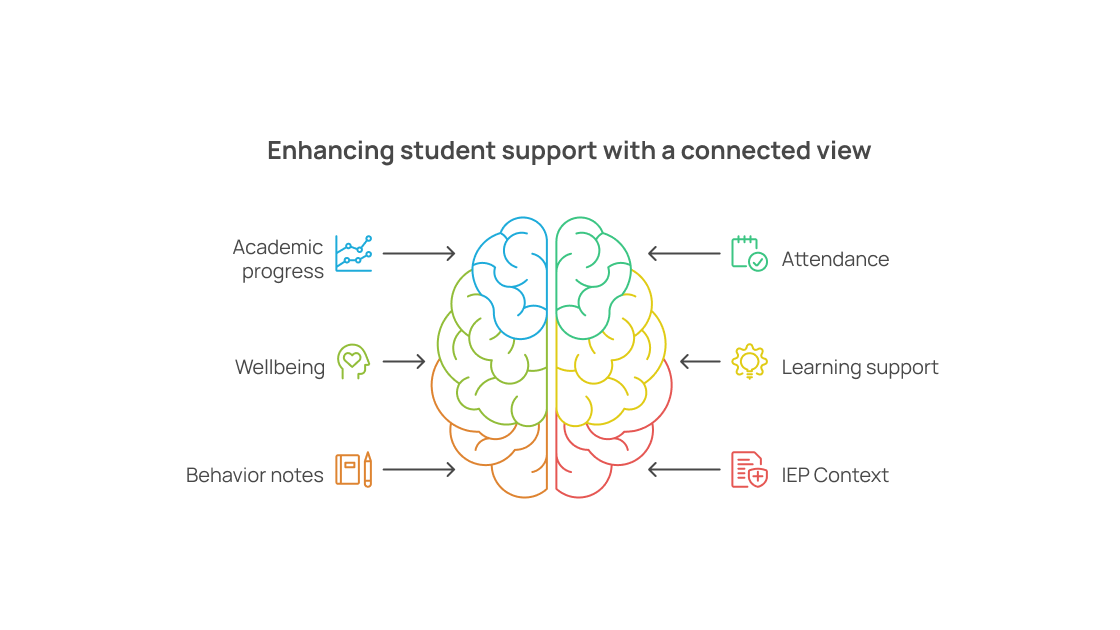
Academic progress, attendance, wellbeing, learning support, behavior notes, and IEP context should not be assembled only when something goes wrong. The right people should have access to the right context as part of normal work.
That changes the standard of care.
Teachers understand students more fully. Support feels more continuous. Leaders can spot patterns earlier. Decisions are shaped by context rather than fragments.
Where schools usually break down
Most schools already have a lot of student information.
The issue is that the information is split across systems, teams, formats, and habits.
A learning support note may not carry forward to a new teacher. A wellbeing concern may be recorded in one place but invisible somewhere else. A year-group handover may depend more on memory than on a shared record. A student’s full picture may exist, but only after someone has taken the time to pull it together.
Staff are still working hard.
But without a connected student view, that effort does not always become joined-up support.
What leading businesses get right
Salesforce is useful here because it was built around one clear relationship principle.
Different teams should not be working from different versions of the same person or account. Sales, service, and support all need shared context so the next action is timely and relevant.
In schools, the relationship is different, but the principle is similar.
A student should not become a set of disconnected records.
What that looks like in a school
A connected student view brings academic progress, attendance, wellbeing, support needs, and IEP context into one usable record.
Teachers should not have to open multiple systems to understand the students in front of them. Advisors should not have to ask colleagues to fill in basic gaps. Support staff should not have to rebuild the context the school already holds.
This is not about collecting more data.
It is about making the data the school already has easier to use at the right moment.
A teacher walks into a lesson with a fuller view. A support coordinator can see patterns across subjects. Leadership can understand how well the school is supporting students as whole people, not only as academic performers.
A 30-day starting plan
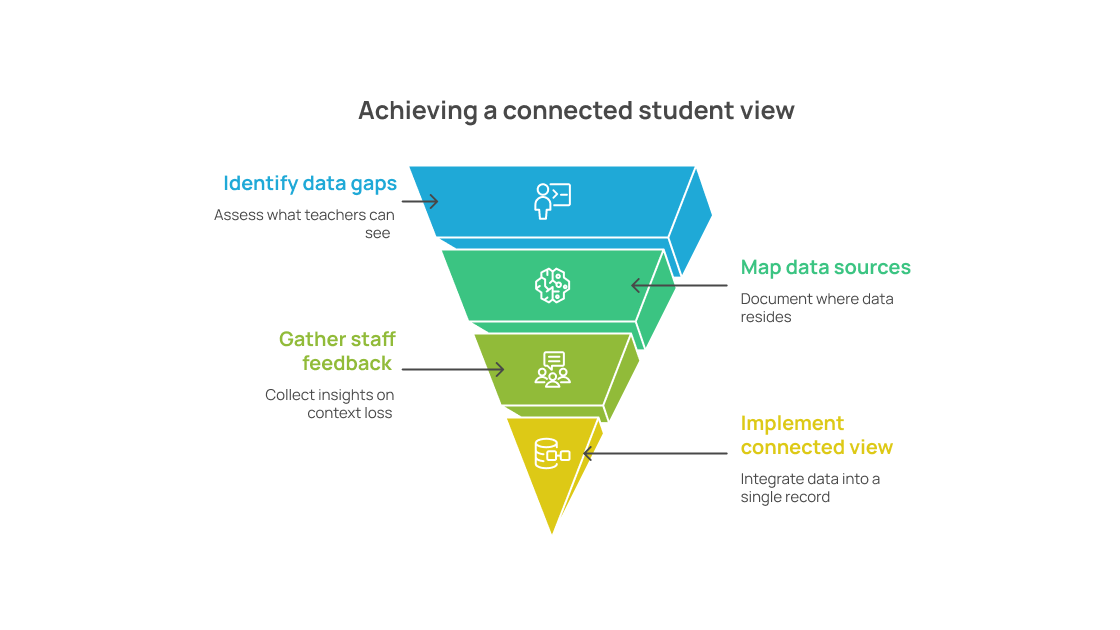
Start by checking what a teacher or advisor can see about a student today without opening another system or asking someone else.
That gap between what the school holds and what staff can actually use is the first issue to address.
Then choose one year group or one support workflow and map where academic, attendance, wellbeing, behavior, and IEP information currently sits. Note who can access it, who updates it, and where it gets lost.
Finally, ask staff where student context is hardest to carry forward. Their answers will show where the system is weakest.
One KPI worth watching
Track the percentage of core student information available in one connected record without manual assembly.
If the full student picture still has to be rebuilt each time it is needed, the school does not yet have a working single view of the student.
Go deeper
4. Finance: Run tuition and cash flow with more discipline
What good looks like
A financially disciplined school is not surprised by its own numbers.
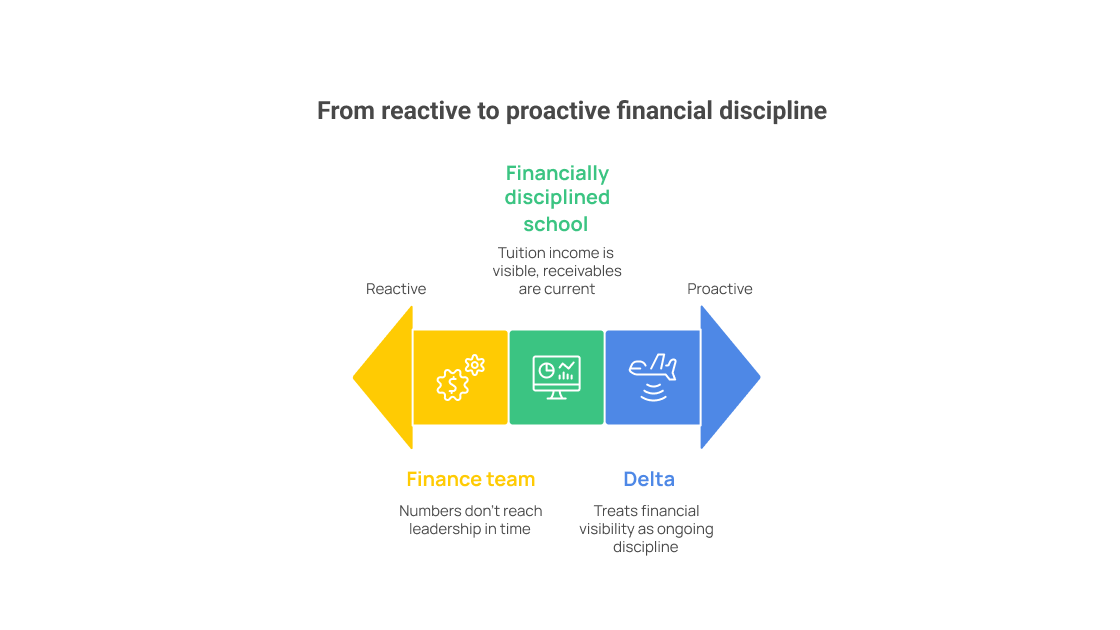
Tuition income is visible. Receivables are current. Finance can answer a board question without rebuilding the report from scratch. Leadership can model what happens if enrollment shifts, payment plans slow, or an unexpected cost arrives.
That gives the school more room to act before pressure narrows the options.
Where schools usually break down
Finance in many independent schools is competently managed but not always visible enough.
The finance team may understand the numbers, but the numbers do not always reach leadership in time to guide decisions. Tuition tracking may rely on spreadsheets. Outstanding balances may build before anyone sees the pattern clearly. Board reporting may require manual preparation that describes a situation which has already changed.
That delay creates risk.
The school may be financially aware, but not financially responsive.
What leading businesses get right
Delta’s approach to scenario planning is useful because it treats financial visibility as an ongoing discipline.
The value is not in predicting the future perfectly. It is in being ready for more than one version of it.
For tuition-dependent schools, that mindset is especially relevant.
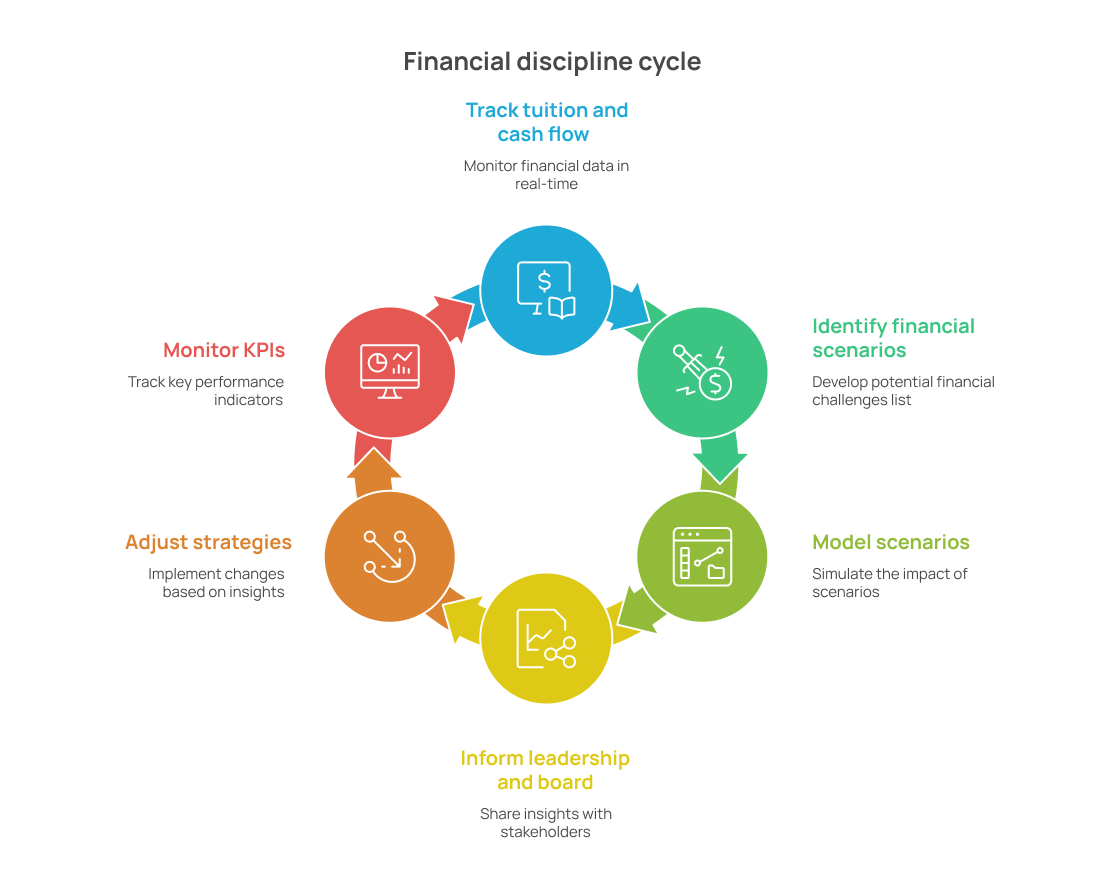
A school should be able to ask what happens if enrollment drops, if receivables rise, if a capital expense lands early, or if family payment behavior changes. Those questions are much easier to answer when tuition and cash flow data are current.
What that looks like in a school
In a school, financial discipline means tuition forecasting is not only an annual exercise.
Leadership can see what has been billed, what has been collected, what remains outstanding, and where attention is needed. Finance can model risk without rebuilding the same data each time. Board reporting comes from live information rather than a report assembled the night before.
This does not require overcomplicated finance infrastructure.
It requires accurate records, automated billing where possible, clear receivables visibility, and a rhythm of reviewing the numbers before they become urgent.
A 30-day starting plan
Start with the current outstanding tuition report.
-
How long did it take to produce?
-
How confident are you in its accuracy
-
How current is the information?
Then identify three financial scenarios that would place pressure on the school over the next twelve months. For many independent schools, the obvious three are an enrollment shortfall, delayed fee collection, and an unexpected capital cost.
Finally, review how financial information reaches leadership and the board. If every meaningful report still requires a major preparation exercise, the financial infrastructure is carrying too much manual work.
One KPI worth watching
Track days sales outstanding on tuition receivables.
When that number rises, it can signal collection friction, family financial pressure, or process weaknesses before those issues become harder to manage.
Go deeper
5. Data: Create one source of truth across the school
What good looks like
A school with clean, connected data does not get different answers depending on who is asked.
Student records, family details, admissions data, tuition information, communication history, and reporting fields draw from one trusted source. The right people can access what they need without checking a second system or reconciling competing versions.
Leadership works from a current view of the school rather than a version prepared after the fact.
Where schools usually break down
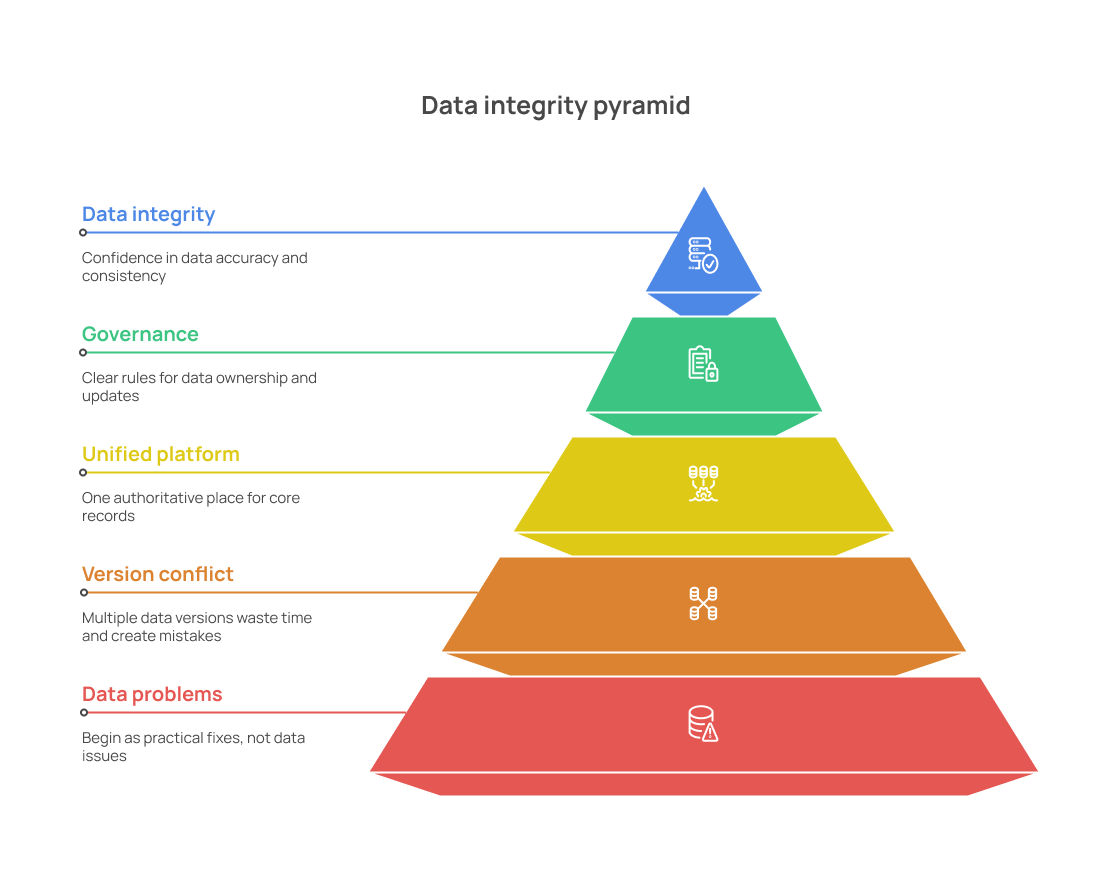
Data problems rarely begin as data problems.
They begin as practical fixes.
A spreadsheet tracks a process. A shared folder becomes the working record. A team creates its own version of a list because the main system is slow or incomplete. One person keeps the cleanest version because everyone trusts their attention to detail.
Each choice makes sense in isolation.
Together, they create several versions of the truth.
A parent updates contact details in one place but not another. Admissions numbers do not match finance. A staff member leaves, and the school is no longer sure which records were maintained properly.
The cost is not only inefficiency. It is confidence.
What leading businesses get right
The useful lesson from large collaborative organizations is simple: version conflict wastes time and creates mistakes.
When teams work from the same live record, conversations can move past “which number is right?” and return to judgment.
Schools need the same clarity, especially around student records, family information, enrollment, tuition, and reporting.
What that looks like in a school
One source of truth means the school has one authoritative place for core records.
Other processes draw from that source instead of creating separate versions. When a student record changes, the relevant teams see the update. When a payment is received, the family account and finance record align. When leadership needs a school-wide view, the answer is already in the system.
This is as much a governance issue as a technology issue.
A unified platform helps, but the school also needs clear rules about who owns each record, where updates happen, and which version is authoritative.
A 30-day starting plan
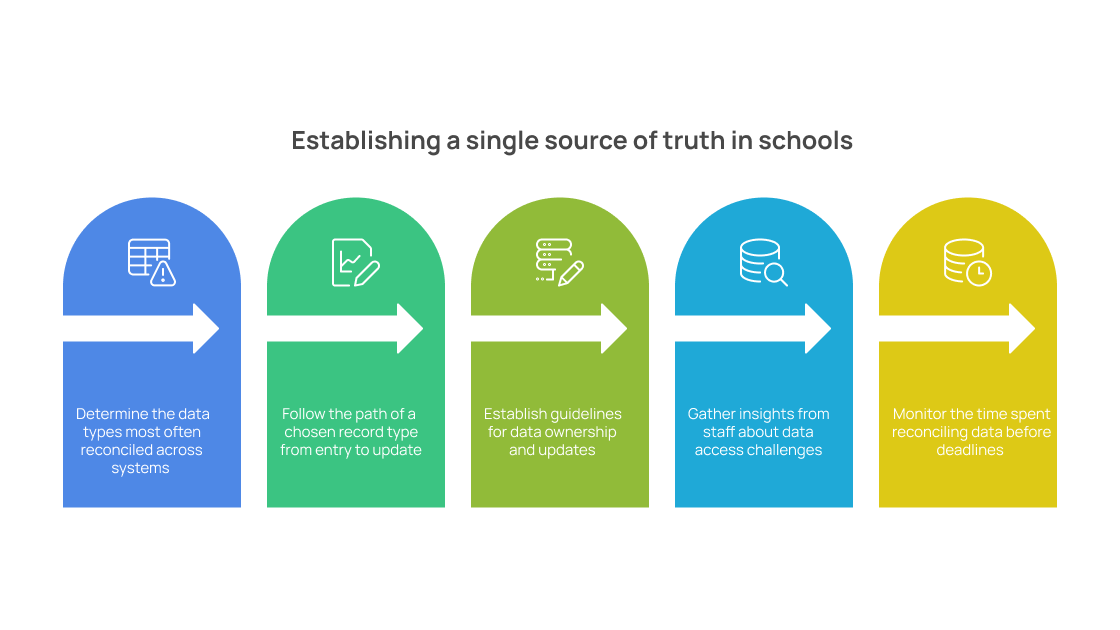
Identify the information your school most often reconciles across systems. Common examples include enrollment numbers, tuition balances, contact details, attendance, and reporting fields.
Choose one record type and trace where it is entered, stored, updated, and checked.
Then set a clear rule: where does this record live, who owns it, and how should changes be made?
Finally, ask staff which questions they cannot answer confidently without checking more than one place. Those answers will show where data integrity is costing the school time.
One KPI worth watching
Track the time required to reconcile data before a board meeting or reporting deadline. If a standard report still depends on manual checking and cross referencing, the school does not yet have a reliable single source of truth. Routine reporting should be a matter of retrieval, not reconstruction.
Go deeper
6. Enrolment: Turn admissions into a managed relationship journey
What good looks like
A strong admissions operation knows where every prospective family stands.
The team can see who has enquired, who has toured, who has applied, who has gone quiet, and where follow-up is needed. The next step is visible. Ownership is clear. Communication feels timely without depending on one person remembering every detail.
That structure changes the family experience.
The school feels prepared, attentive, and easy to trust before the student even arrives.
Where schools usually break down
Many schools manage admissions through email threads, spreadsheets, and staff memory.
That may work while enquiry volume is low. It becomes fragile when volume increases, responsibilities shift, or the admissions cycle gets busy.
Families fall through the gaps. They enquire and wait too long. They tour and do not receive a clear next step. They accept a place but receive mostly logistical information just before term begins.
The issue is not care.
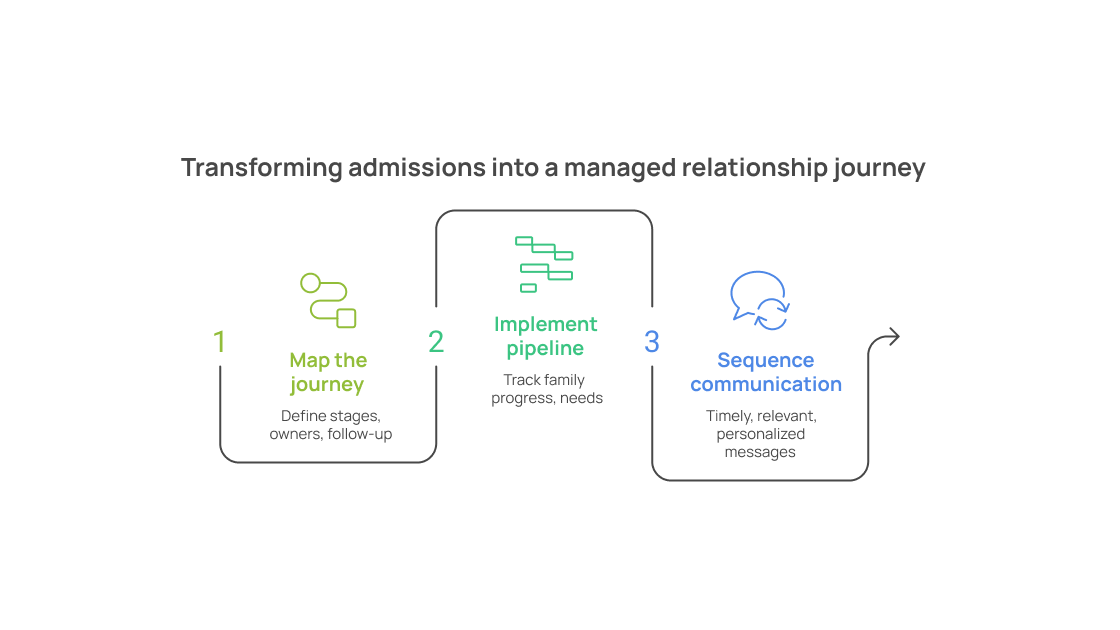
It is the absence of a visible relationship journey with defined stages, owners, and follow-up.
What leading businesses get right
HubSpot’s lesson is relevant because it treats relationships as something actively managed.
Each stage has a next action. Each relationship has an owner. Follow-up is visible. The process does not rely on someone remembering to check an inbox at the right time.
That principle fits admissions naturally.
A prospective family is not a transaction. It is a relationship that needs structure, context, and timely communication.
What that looks like in a school
In a school, admissions should be managed as a relationship journey from first enquiry to enrolled family.
The pipeline should show where each family is, what they have received, what they still need, and who owns the next step. Communication should be sequenced rather than improvised. Onboarding should begin before the first day, not after the contract is signed.
That is especially important for independent schools, where choosing a school is personal, emotional, and often expensive.
Families are not only evaluating curriculum. They are looking for signs that the school is organized, attentive, and ready to support their child.
A 30-day starting plan
Map the admissions journey from first enquiry to enrolled family.
Identify where families most often pause, disappear, or need manual follow-up. Then review the last twelve months of enquiries and check how many moved to application, acceptance, and enrollment.
If those numbers are hard to produce, the admissions pipeline does not yet have enough visibility.
Finally, review what accepted families receive before the first day of school. If the experience is mostly administrative, strengthen the onboarding journey.
One KPI worth watching
Track inquiry to enrolment conversion by stage. A school that knows only its final conversion rate, but cannot see where families are dropping out along the way, is managing the result rather than the process that produces it.
Go deeper
7. Legal: Make compliance and reporting part of the workflow
What good looks like
A school that handles compliance well does not treat reporting readiness as a separate project.
Audit trails, consent records, ministry reporting fields, financial documentation, and governance records are maintained through normal work. When a deadline arrives, the school is compiling and reviewing rather than rebuilding.
The preparation is lighter because the discipline has already happened upstream.
Where schools usually break down
Many schools manage compliance through reminders, manual checking, and the knowledge of a small number of experienced staff.
That model works until it does not.
A key person is absent. A deadline shifts. A report requires data from several systems. An audit question needs a clear record, but the answer has to be reconstructed.
The deeper issue is that reporting is treated as a seasonal event.
Schools prepare for deadlines instead of maintaining readiness throughout the year.
What leading businesses get right
The useful business lesson here is continuous compliance.
Stronger organizations build control, documentation, and audit trails into daily workflows. That makes reviews faster, lowers risk, and reduces the last-minute scramble.
Schools can use the same principle without making compliance feel heavier.
The goal is not more admin. The goal is cleaner records during the year, so reporting does not become a separate burden at the end.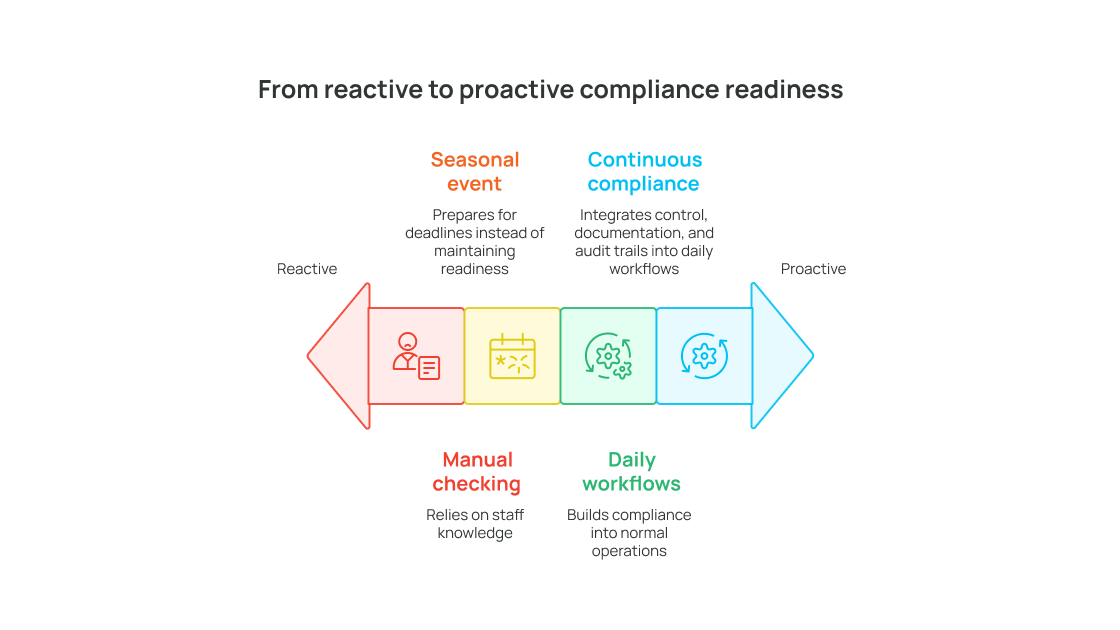
What that looks like in a school
Canadian independent schools deal with recurring provincial and governance reporting requirements.
The details differ by province, but the operating need is the same: records must be accurate, current, and easy to produce when required.
When student records are maintained in a reporting-ready format, ministry submissions become easier. When consent logs and governance documents live in reliable systems, the school is less exposed to staff turnover or last-minute searching. When financial documentation is kept clean throughout the year, board and audit conversations are less disruptive.
Compliance becomes part of how the school operates, not a separate production cycle.
A 30-day starting plan
List every recurring reporting and compliance obligation across the school year. Include ministry reports, financial filings, governance records, consent documentation, and privacy-related processes.
Then mark which ones still require significant manual preparation before they are due.
Choose the most labour-intensive item and trace where the underlying data lives, who maintains it, and what has to happen before it becomes submission-ready.
Finally, identify which obligations depend too heavily on one or two staff members. That is a risk worth reducing before it becomes urgent.
One KPI worth watching
Track the time required to produce a standard ministry or board report from existing records. If a required report still takes days of preparation rather than hours of compilation, the school’s records are not yet supporting confident, low friction compliance.
Go deeper
8. Risk: Plan early for the problems schools cannot ignore
What good looks like
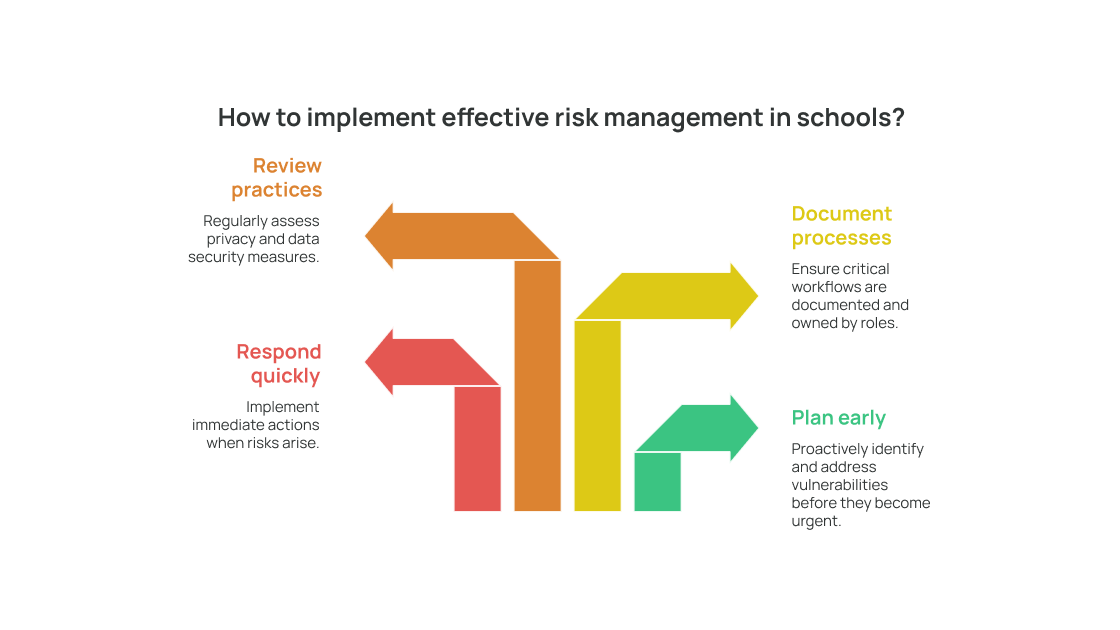
A resilient school has already thought through its main vulnerabilities before they become urgent.
It knows what happens if enrollment drops. It has a plan for staff absence. It has reviewed data security, privacy practices, emergency procedures, insurance coverage, and critical workflows recently enough to know they still reflect reality.
This does not require a dedicated risk department.
It requires the habit of asking difficult questions while there is still time to answer them calmly.
Where schools usually break down
Risk planning often starts after something has already gone wrong.
A cash flow issue appears, and scenario planning becomes urgent. A staff member leaves, and an undocumented process becomes a problem. A privacy or safeguarding concern exposes gaps that have not been reviewed in years.
That delay is understandable.
When nothing feels urgent, risk planning loses space to everything that is urgent. But the cost of that delay becomes visible all at once.
What leading businesses get right
Strong risk management does not mean expecting every bad scenario to happen.
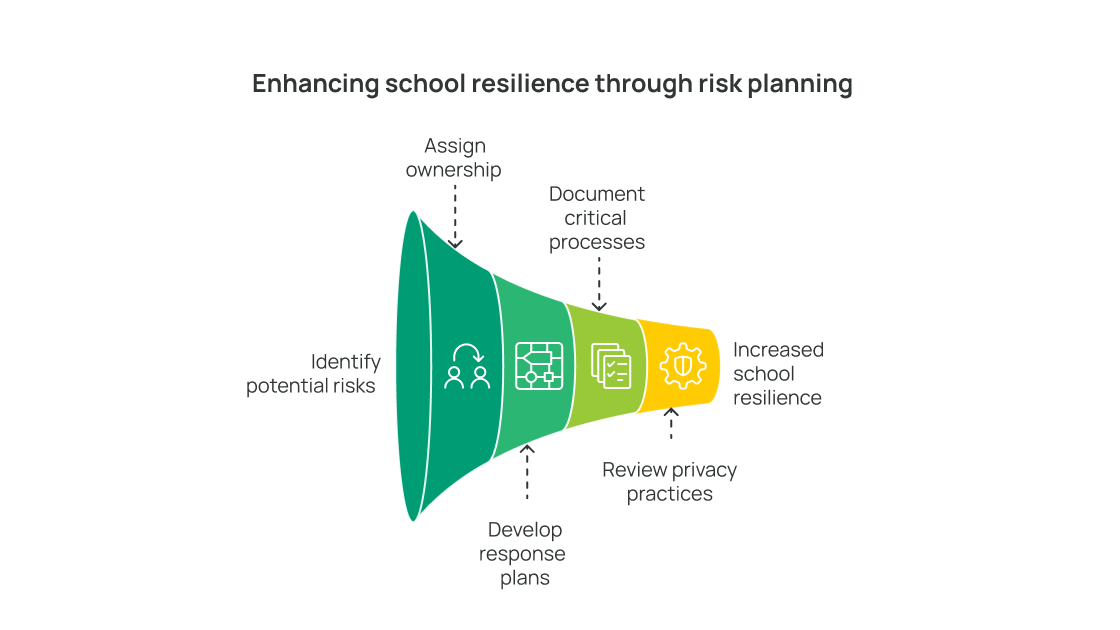
It means naming the likely vulnerabilities, assigning ownership, and deciding what the first response should be.
Once a risk has been named clearly, the school can make better decisions around it.
 What that looks like in a school
In a school, the most important risks are often concentrated in a few places.
Tuition revenue depends on family retention. Key workflows depend on individual staff members. Data may sit in systems that are hard to audit or recover. Privacy policies may not fully match how data is used day to day. Emergency procedures may not reflect current staffing, buildings, or technology.
These risks rarely need dramatic solutions.
They need honest assessment, clear ownership, and a practical response plan.
-
What happens if enrollment drops by 10 percent?
-
Who steps in if the person who manages reporting is absent for a term?
-
When was the last time the school checked whether its privacy practices match what families have been told?
Those are the questions resilient schools answer early.
A 30-day starting plan
Identify the three scenarios that would place the greatest strain on the school over the next twelve months.
Then check whether each one has an owner, a first response, and enough information to act quickly.
Next, list the critical processes that still depend on one person. Choose one and document it this month.
Finally, review when the school’s privacy and data security practices were last checked against how data is actually used today.
One KPI worth watching
Track the percentage of critical operational processes that are documented, tested, and owned by a role rather than an individual. When key processes live in people more than systems, the school is carrying more operational risk than it may realise.
Go deeper
9. Governance: Lead with goals, KPIs, and visibility
What good looks like
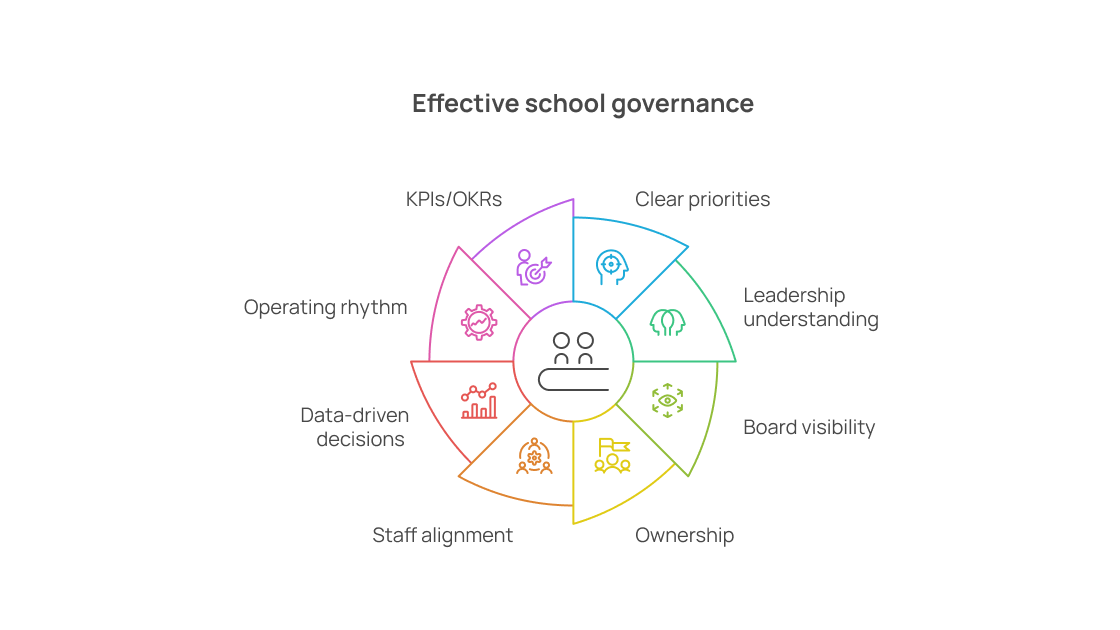
A well-governed school works from a small number of meaningful priorities.
Leadership understands them. The board can see progress. Owners are clear. Staff know how their work connects to the direction of the school. Reporting supports decision-making instead of consuming the meeting.
That clarity does not appear because the strategy document exists.
It appears when strategy is translated into an operating rhythm.
Where schools usually break down
Most schools have a strategic plan.
Fewer have a practical way to run against it week by week.
Goals are set, then gradually lose force. KPIs are defined, but not reviewed often enough to guide action. Board meetings drift into operational updates because the right information is not ready in a useful format. Leaders know the direction, but the system does not help them manage progress against it.
The plan may be sound.
The operating rhythm around it is often too weak.
What leading businesses get right
Intel’s use of objectives and key results is a useful example because it made priorities visible often enough to shape action.
The value was not in measuring everything.
It was in making the right things visible, assigning ownership, and reviewing progress before issues became fixed.
Schools can use the same discipline without turning governance into a dashboard exercise.
What that looks like in a school
In a school, this means choosing a small number of priorities for the term or year and defining what progress should look like.
That could include enrollment against target, student retention, tuition collection, parent satisfaction, staff turnover, reporting readiness, or adoption of a new workflow.
The specific measures will vary by school.
The principle does not: leadership and the board should be able to see progress without waiting for someone to assemble the story manually from several systems.
A 30-day starting plan
Take the current strategic priorities and reduce them to the few that genuinely guide decisions this term.
For each one, define one measurable result, one owner, and one review rhythm.
Then test the reporting process. How long does it take to prepare the numbers needed for a meaningful governance conversation?
If the answer is days rather than minutes, the issue is not only reporting. It is visibility.
One KPI worth watching
Track the percentage of strategic priorities with a defined KPI, a named owner, and an active review rhythm. If that number is low, governance is still sitting too far away from daily operations.
Go deeper

The capabilities that matter most
Feature count is not the real test.
The better question is whether the system supports how the school actually runs.
Student, family, and financial data should live in one trusted base. If they sit across separate systems, staff end up maintaining several versions of the same record.
Workflows should move without constant follow-up. If admissions, billing, communication, or reporting depends on someone remembering each next step, the process will slow down under pressure.
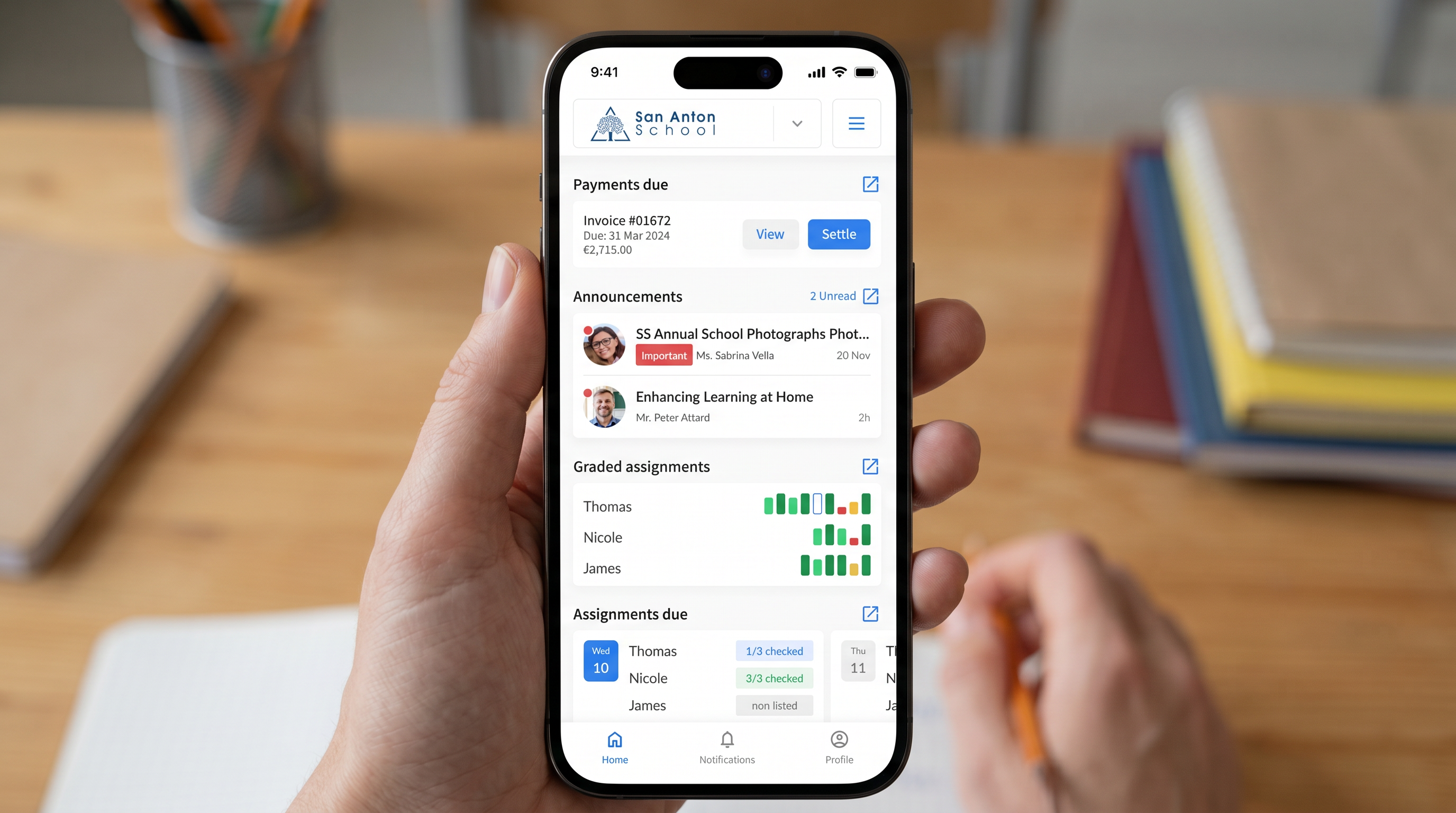
The parent experience should feel clear and consistent. Families should not have to search for information, repeat requests, or move between different systems depending on the task.
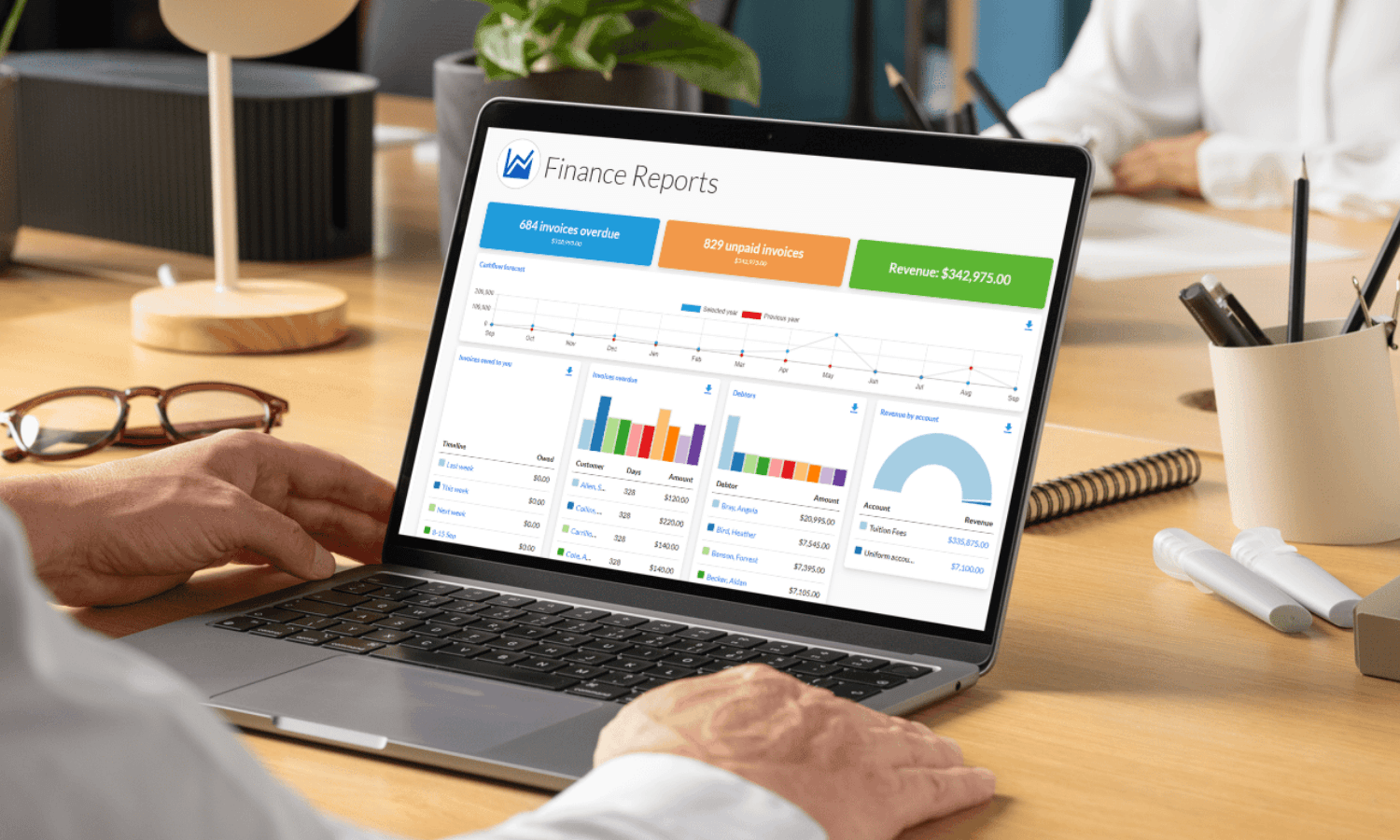
Tuition should be visible as it happens. Leadership should be able to see what has been collected, what remains outstanding, and where attention is needed without waiting for month-end reconciliation.
Specialist tools may still have a place. The problem begins when they do not connect cleanly to the core system, because every disconnect creates another operational gap.
Access should be controlled without obstructing work. Staff need the information required for their role, while sensitive records remain properly protected.
Reporting should come from live data. If a board report still requires numbers to be assembled from different places, the system is not yet doing enough of the work.
These are not advanced extras.
They are the conditions that help a school run with more clarity, control, and confidence.

Where the real school stories connect
The clearest way to test this argument is to look at schools that have already changed how they work.
Okanagan Christian School faced a familiar pattern: disconnected modules, missed parent communication, slow support, difficult reporting, and software costs that kept growing through add-ons.
After moving to MySchool, parent engagement increased from under 50% to over 60%. Report card preparation dropped from a full day to about an hour. Government audit work that once took multiple days became a matter of review and export. Annual software costs fell by around $10,000.
The value was not only technical.
The school gained a stronger operating base around the same educational mission. Staff spent less time fighting the system. Leaders could trust information more quickly. Families became easier to reach, and the school had clearer evidence that communication was being received.
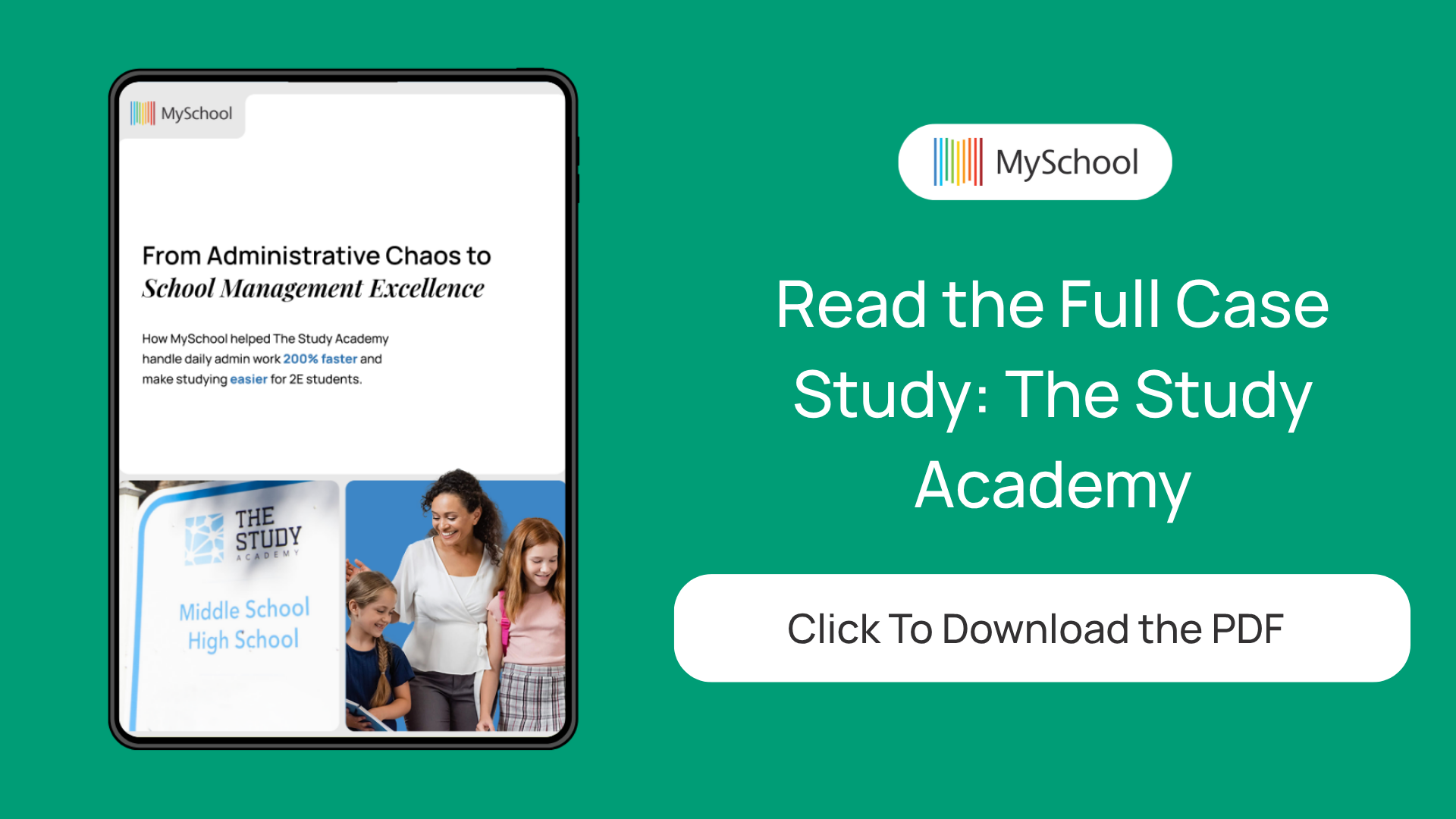
The Study Academy shows the same argument in a different context.
As an independent school supporting twice-exceptional students, it needed systems that could handle sensitive IEP workflows, secure student information, Ontario reporting, flexible scheduling, attendance follow-up, family communication, and staff adoption across a specialized learning environment.
Once those processes were brought into one platform, the change appeared in the rhythm of daily work.
School-wide announcements that once took 15 to 20 minutes could be sent in seconds. Attendance follow-up that once took 90 to 120 minutes each morning dropped to a few minutes. Staff could view attendance, behavior, grades, and student support data together, which made it easier to act from a fuller understanding of each student.
These stories are useful because they make the larger point concrete.
Better systems do not replace the work of a school. They give that work a steadier foundation.
For some schools, the next step is not optimization, it’s switching
In some schools, process improvement within the current setup is enough.
In others, the system itself becomes the constraint.
When core processes still require manual work to stay connected, reporting still depends on pulling information from several sources, and visibility remains partial after sustained effort, the question changes.
It is no longer only, “How can we improve this process?”
It becomes, “Is this platform still fit for the way our school needs to operate?”
For Canadian independent schools, that question is especially practical.
Data hosting, provincial reporting, CAD billing, compliance, implementation support, and day-to-day usability all shape whether the platform can support the school under real conditions.
As operational expectations rise, the system underneath them has to rise with them.
If you’re comparing MySchool and other options like Blackbaud, you’re likely already trying to find a better fit for how your school operates.

Data residency, currency, and compliance matter
For Canadian schools, where data is stored and how it is handled is part of the school’s responsibility to families.
Privacy expectations are shaped by legislation such as PIPEDA and, in some provinces, additional local requirements. Hosting student and family data on Canadian servers gives schools a clearer position in privacy, governance, and board conversations.
Financial operations carry the same practical logic.
Billing in Canadian dollars removes exchange-rate uncertainty, avoids unnecessary transaction friction, and makes tuition revenue easier to forecast and explain.
These details may sound operational, but they affect trust.
Compliance, auditability, reporting readiness, and financial predictability are easier to maintain when the system is designed around the school’s actual context.
For Canadian independent schools, those are not edge cases. They are part of daily operating reality.
Why MySchool is the best platform to run your school with business-grade discipline
Which system can support this way of working every day?
For a school, stronger operations mean the work behind the mission runs with more clarity, more consistency, and less strain on the people holding it together. Core records stay connected. Workflows are easy enough to follow without private workarounds. Reporting comes from information the school already trusts. Families experience communication that feels coordinated because the school itself is working from a shared view.
That is the model MySchool is built to support.
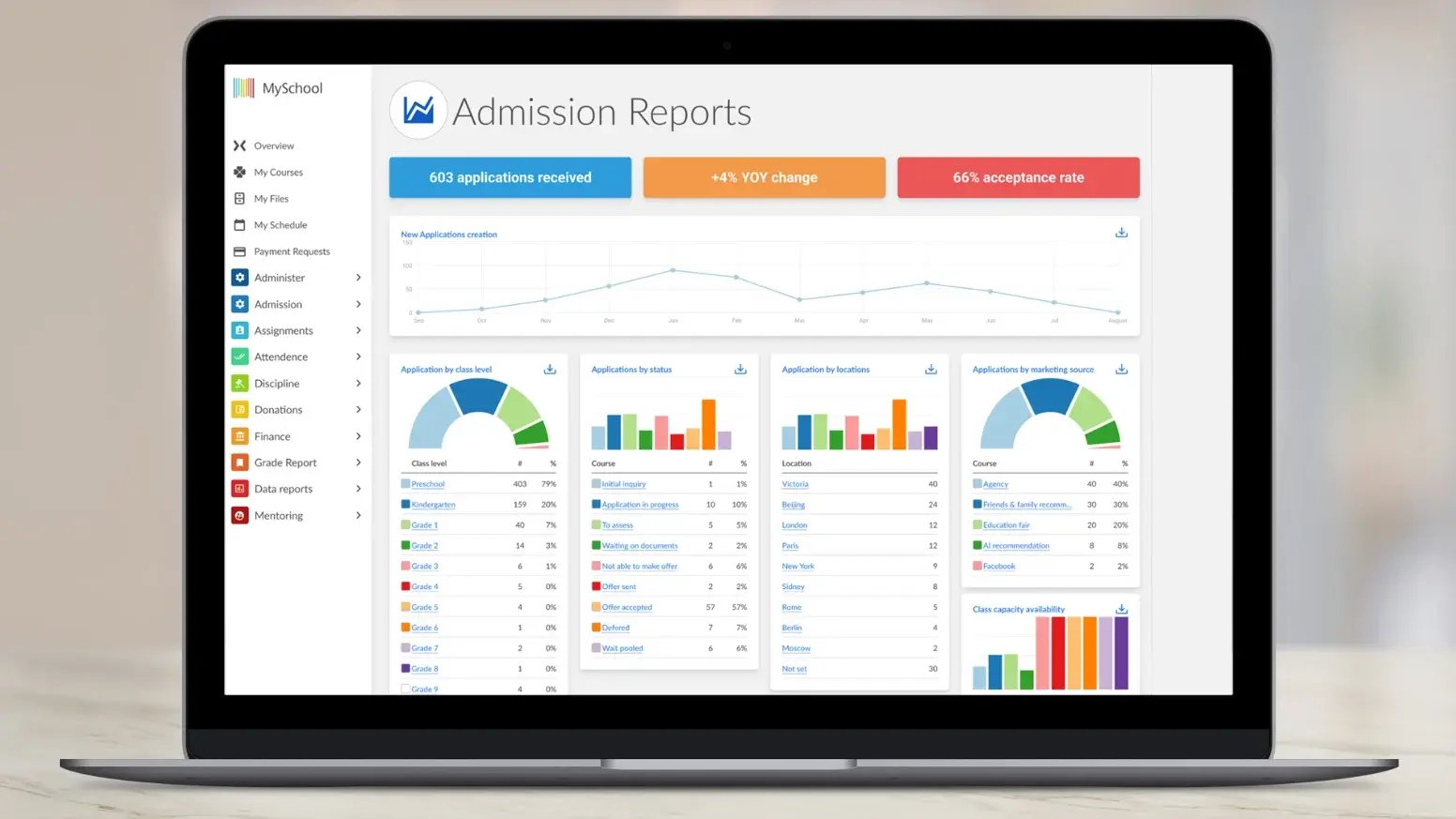
MySchool brings the core work of an independent school into one connected platform, including academics, admissions, tuition, communication, provincial reporting, student records, parent engagement, LMS, and IEP workflows.
This gives leaders a clearer view of what is happening, gives staff fewer systems to reconcile, and gives families a more consistent experience of the school.
Many schools reach this question after years of adding tools one at a time.
A spreadsheet here. A finance tool there. A communication platform somewhere else. A reporting process that depends on the person who knows where everything lives.
The school keeps moving, but the model becomes harder to sustain.
MySchool gives schools a more coherent way forward: one connected platform, Canadian fit, and a customer success model designed to make the move manageable.
Built for Canadian independent schools, not retrofitted for them
Canadian independent schools work inside a specific operating context.
Their systems need to support provincial reporting, privacy expectations, data residency concerns, board accountability, tuition realities, and lean administrative teams that cannot afford unnecessary complexity.
MySchool was built around that context from the start.
Canadian data hosting gives schools a clearer answer when leaders, boards, or families ask where school data lives. Provincial reporting support helps reduce pressure around recurring ministry requirements, including workflows for provinces such as Ontario and British Columbia. CAD invoicing makes budgeting cleaner for finance teams and avoids exchange-rate surprises.
That local fit has a practical effect.
When a platform understands ministry reporting, staff spends less time reshaping data to fit external requirements. When pricing and invoicing are handled in Canadian dollars, finance teams can plan with more confidence. When data is hosted in Canada, leadership can approach privacy and governance conversations with a stronger position.
It also makes the buying decision easier for a committee.
Heads of School, finance teams, admissions, operations, teachers, IT, and board members all look at school management software through different concerns. MySchool gives those stakeholders a shared answer: a connected platform built for the way Canadian independent schools actually operate.
Book a demo
If your school is ready to see how this operating model works inside MySchool, book a demo with our team.
We can walk through the areas that usually create the most operational pressure, including admissions, tuition, communication, reporting, attendance, student records, LMS, IEP, and the parent experience.
We can also show how MySchool supports Canadian school requirements, including data hosting, provincial reporting, and CAD invoicing.
The conversation is practical.
We look at how your school manages the work that keeps everything moving, from admissions and tuition to communication, reporting, student records, and parent experience. Then we show how MySchool brings that work into one clearer operating environment.
So your team can spend less time holding fragmented processes together and more time leading the school with confidence.